
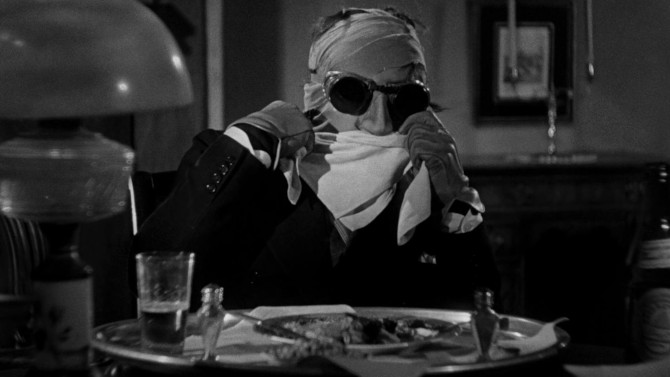


Dr. Jack Griffin: “We’ll begin with a reign of terror, a few murders here and there, murders of great men, murders of little men – well, just to show we make no distinction. I might even wreck a train or two… just these fingers around a signalman’s throat, that’s all.”
For one of the soon to be illustrious monsters for their slate of horror movies, Universal turned to the writing of H.G. Wells, bringing to life his novel The Invisible Man (1933), with the director of 1931’s Frankenstein, James Whale, given another opportunity to envision one of their fiends for cinematic life.
Combining technical precision, maniacal madness, and more than a touch of Whale’s famed black comedy, the classic tale follows an on the run Doctor, Jack Griffin (basically just Claude Rains’ masterful voice doing all the work. . . though he wasn’t the original choice – Frankenstein stars Boris Karloff and Colin Clive both said no), who finds his way to a tiny British village.
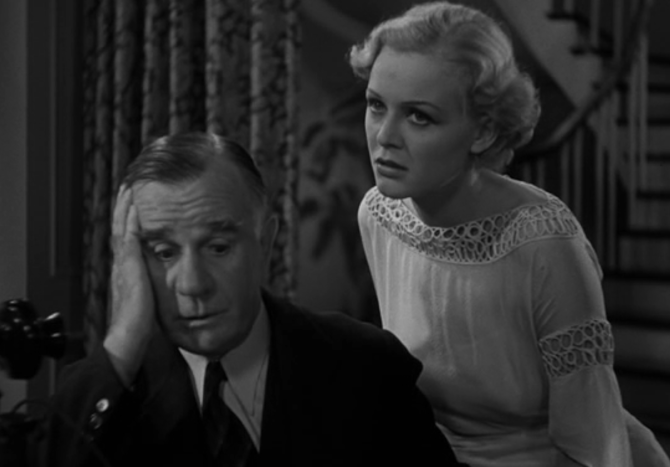
Fleeing his scientific partners Dr. Kemp (William Harrigan) and Dr. Cranley (Henry Travers – Clarence from It’s a Wonderful Life), as well as fiancée Flora Cranley (Gloria Stuart – the elderly Rose in Titanic), he’s simply looking for some peace and quiet to fix his scientific experiment gone wrong. . . which, as you might have guessed, has made him invisible; alas, he finds no such thing – with the soon to be spooked tavern co-owner, Jenny Hall (Una O’Connor), continuously interrupting him, making his already short fuse even shorter.
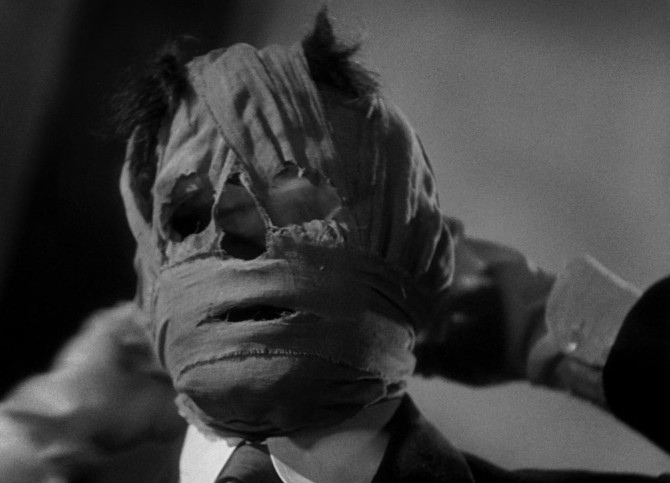
Leading to a fully transformed and severely agitated Invisible Man rampaging through the British countryside (for his plan, see the quote that opens the piece), it certainly doesn’t help that the scientific formula has also given him extra strength and delusions of grandeur. Going from spooking and stealing, all the way to multiple murders, the at first unbelieving cops will soon learn that all the community gossip is true and that they’re in for a near impossible criminal to catch. Will Dr. Griffin’s former friends or fiancée stand a chance in convincing him to trust them? Could the bumbling county police have a plan to foil the unhinged mastermind? Or might the dreaded surprising British snowfall convince the man to give up on his naked ways?
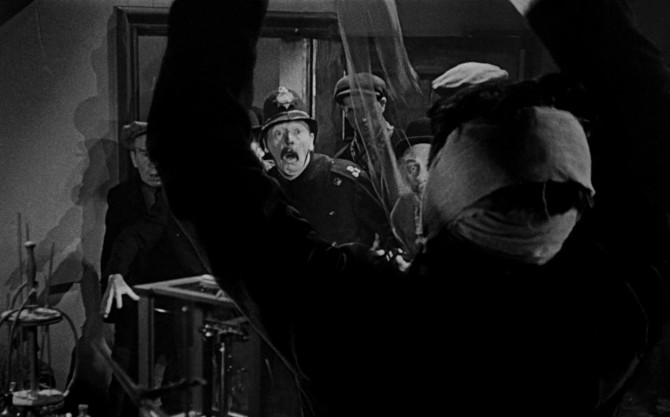
Pairing a fantastic combination of scares and comedic camp, it’s still quite impressive just how sharp this looks today (especially after seeing the effects in the recently reviewed Reptilicus – which was made almost thirty years later). Shot with both skill and attention to detail (a black velvet suit and non-reflective velvet background is part of the secret), one of the more impressive moments finds the Invisible Man removing his bandages in front of a mirror – a sequence that needed four different camera shots composited together to get the final realistic effect.
When combined with the maniacal laughter and mesmeric menace found in Rains’ voice and the over the top reactions from the entertainingly comedic cast, you’ve got a perfect pairing of all the cinematic pieces coming together to form something that, in reality, is meant to be invisible.
With The Invisible Man coming off a tad like an early precursor to the Abbott and Costello monster movie comedies that would arrive from Universal some ten plus years later, it’s a rare early example of a director truly understanding how pairing these two very different genres together could work so well. It is also worth noting that there are some wild cameos throughout: notice Dwight Frye (the original Renfield in Dracula and Fritz in Frankenstein) appearing as a reporter in the police office; Walter Brennan as the bicycle owner in the bar scene investigation of the Invisible Man; and John Carradine as a concerned citizen calling in with a tip on how to catch the unseen villain. So, after all these years, please help make this horror classic visible again.