


Dr. Judson Uhl: “Why is it always, always so costly for Man to move from the present to the future?”
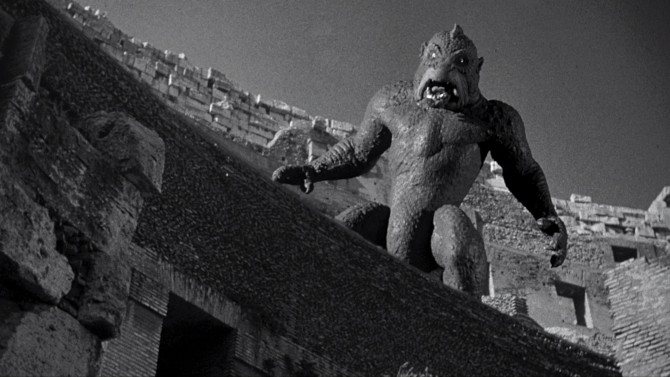
Despite not being written or directed by the famed special effects expert Ray Harryhausen, that latter honour going to Nathan Juran instead, there is no denying that the magic man’s hands are all over this horror infused sci-fi monster bash. Spawning the unique concept originally titled as The Giant Ymir, while also suggesting it be set in Rome, Italy instead of the United States (why you may ask. . . he simply always wanted to vacation there), whilst also being in charge of the stop-motion animation that makes this feature succeed, the final product eventually became known as 20 Million Miles to Earth (1957).
A strong warning of the fears of moving too quickly into ‘futuristic’ ways, which is clearly a callback to ample anxiety revolving around the atomic bomb. . . which, with it, could bring possible nuclear annihilation, here we have the result of space exploration of the planet Venus.
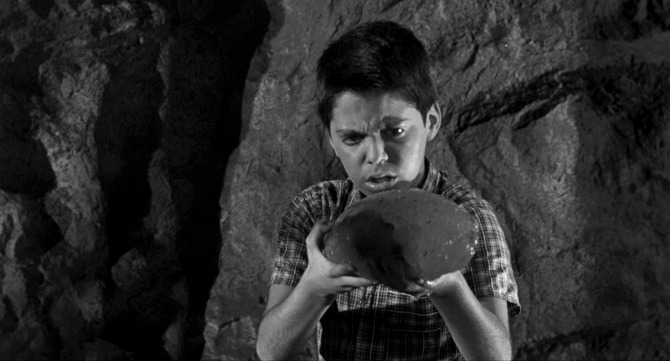
Starting in a little fishing village in Italy, a giant spacecraft returning from Venus crash lands in the Mediterranean Sea. . . a sole boat manned by fishermen Vericco (George Khoury), Mondelo (Don Orlando), and young apprentice Pepe (Bart Braverman) decide to go investigate and see if there are any survivors.
Pulling two men out before the ship sinks, sadly only Col. Robert Calder (William Hopper) survives the rescue. Yet, unbeknownst to everyone else, Pepe discovers a bizarre metal capsule that holds a tiny mysterious creature. . . that he promptly sells to Dr. Leonardo (Frank Puglia) – a zoologist who is researching animals in the area.
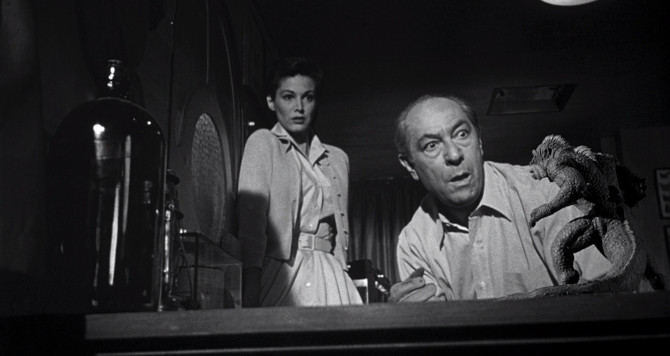
As these things do, it just so happens that a doctor is needed for Col. Calder (after all, it is a small village with only one medical professional in the area), and that Leonardo’s granddaughter Marisa (Joan Taylor) just so happens to be very close to being a full fledged doctor. . . so she decides to help.
Soon, this unusual beast, looking quite scaly and prehistoric, starts to grow at an alarming rate. It does not take long for it to break loose of its lackluster cage, seeming happy to rampage the vast Italian countryside. Of course, we know that saying ‘all roads lead to Rome’. . . but will this one? If so, another old adage comes to mind: ‘Rome wasn’t built in a day’, but even that might be reverse tested. . . as one has to wonder if the Ymir monster could demolish it in a day.

Okay, enough ruminating. . . with the Italian military soon being infringed upon by their American counterparts, the former wish to kill it and save their citizens, while the latter prefer to capture and study the creature. Whose side will cave? Might it all be for naught if they spend too much time arguing over things and give the reptilian life form time to evolve to an even more monstrous size? Meanwhile, might the spaceman and his newfound doctor fall for each other along the bumpy way. . . or is there not enough time for that type of hanky panky when his exploration team is partially at fault?
Combining inspiration from the legendary King Kong, tense Cold War tensions of the time, as well as age old ruminations of whether or not we are all alone in the Universe, 20 Million Miles to Earth is a black and white fantastical horror tinged adventure epic that thrives thanks to Ray Harryhausen’s majestic stop-motion work. Though Harryhausen desperately wanted to shoot the movie in colour, it did not happen at the time due to budgetary constraints, the man finally realized his dream back in 2007 for its fiftieth anniversary (for those interested, I watched the original black and white edition). It is also worth noting that this motion picture inspired the one and only Gene Simmons – his demon walk directly inspired by the movements of Harryhausen’s Ymir creature. . . and I thought he was supposed to be a Demon in Kiss. So, see this shockingly colossal monster movie, it might give new meaning to a gladiatorial fight.