
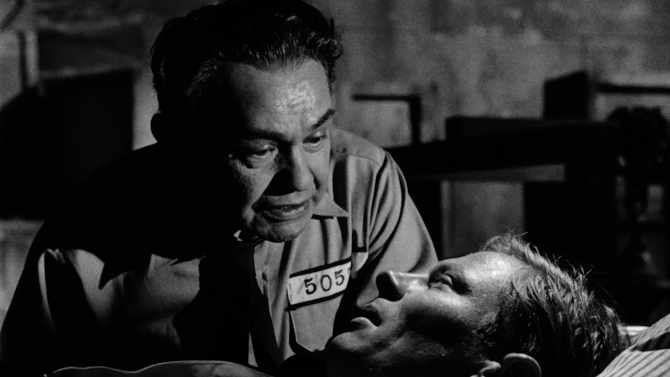


Father Slocum: “Listen to me, Vincent. . . you can’t keep on killing and killing.”
Vincent Canelli: “No? Just watch me.”
Starting by taking you deep within one of the darkest places on earth, death row has never looked so grim and venomous than in the crime drama film noir Black Tuesday (1954), written by famed gritty story/screenwriter Sydney Boehm (Mystery Street; Seven Thieves) and directed by Hugo Fregonese.
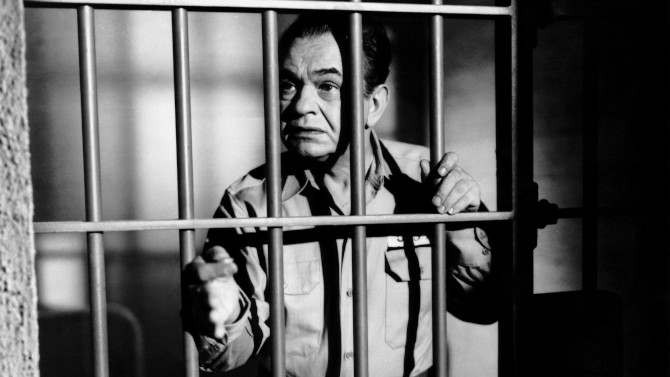
Opening by demonstrating the depressing conditions for those within the wing of that hopeless part of the jail, the lengthy one take starting sequence captures the men behind bars on death row (shot with the shadows showing them trapped by a whole second set of tenebrous silhouettes).
Inside are some of the baddest brutes you’ll ever see, perhaps no more so than soon to be electrocuted criminal mastermind Vincent Canelli (Edward G. Robinson – Key Largo; Vice Squad; Double Indemnity). . . though the much younger Peter Manning (Peter Graves – yes, from the iconic original Mission: Impossible television show; and Night of the Hunter), who once dreamed of being a bridge architect, is also soon destined for the electric chair for killing a cop as well as stealing two hundred grand (not too shabby on the crime topping list either). . . problem is, he is the only one who actually knows where the cash is.
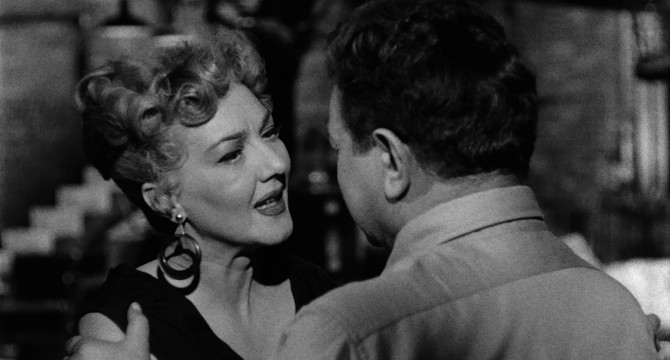
Though people should always be on guard for dangerous dames, Canelli’s girlfriend Hatti Combest (Jean Parker) concocts a conniving plan that allows the entire slate of prisoners to escape thanks to kidnapping, blackmail, as well as some wily deceit and trickery.
Soon, some of the most dangerous people in jail are on the outside, now with five innocent hostages and a solid extended getaway plan. . . with them are prison priest Father Slocum (Milburn Stone), penitentiary MD Dr. Hart (Vic Perrin), cruel guard Lou Mehrtens (Hal Baylor), a young newspaper writer Frank Carson (Jack Kelly – Forbidden Planet), and the daughter of another guard, Ellen Norris (Sylvia Findley).
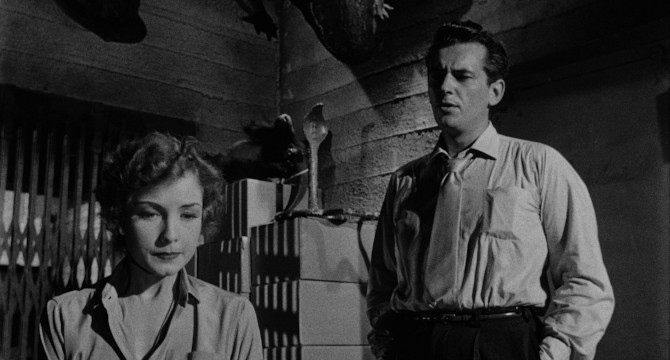
As things seem to be going off without a hitch, can the luck still stay on the side of these hardened criminals the longer the plan plays out? Will Peter Manning be willing to play ball and disclose where the money is to ringleader Vincent Canelli? Or, may their time run out if the coppers catch up to them?
Also strikingly shot with the help of skilled cinematographer Stanley Cortez (Vice Raid; The Magnificent Ambersons; Night of the Hunter), the feature is chock full of the aforementioned barred lighting, startling silhouettes, and an oppressively confining mood. It oozes, while its crime also fits well within the noir scheme of things, even though it might distance itself from focusing more on femme fatales and other such elements of the genre.
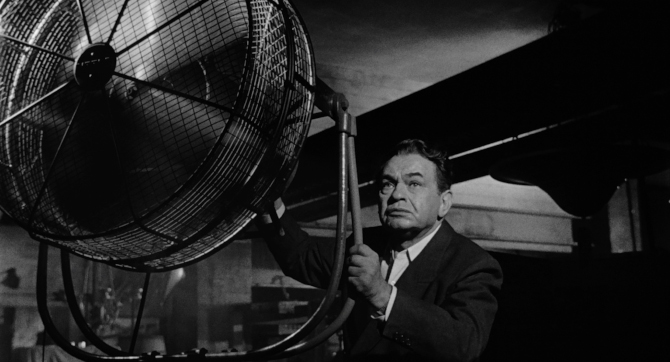
A solid if dark crime-filled film noir shot on a lower than average budget (in fact, in some places like Memphis it was banned due to its grimness and brutality), Black Tuesday thrives thanks to lingering in the shadows, hiding its flaws in the darkness, muting the edges while focusing on the key players and their worried or ominous visages. Capturing Robinson as a kill happy crazy, he’s more than game to enter that unsavory realm, while Graves balances both sides as a shady if possibly redeemable man. Also keep an eye out for Gilligan’s Island Professor Russell Johnson in an early film role (which came shortly after his appearance in the sci-fi movie They Came from Outer Space). Lastly, a cool touch finds the gang at one point hiding out in a movie theatre which is showing The Raid (also 1954) – which just so happens to be written by Sydney Boehm as well. So, avoid death row and see this edgy feature, it is most certainly worth a shot.