
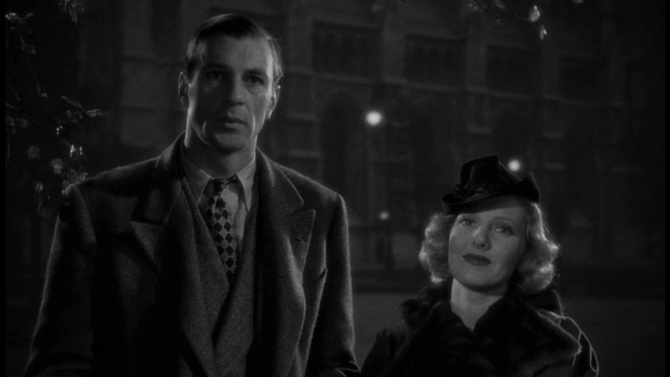


Longfellow Deeds: “People here are funny. They work so hard at living they forget how to live.”
After a middling success with Broadway Bill (1934), Frank Capra wanted to return to the gargantuan success he had with his film released earlier that year, the rare Academy Award winner of the ‘Big Five’, It Happened One Night. Turning pen to paper with his then go to writer Robert Riskin, they worked on developing a tale based upon Clarence Budington’s short story “Opera Hat” – which was turned into serial form in The American Magazine, and it soon became the director’s biggest box office success yet, Mr. Deeds Goes to Town (1936).
Certainly part of why Frank Capra’s work would become known as ‘Capracorn’, this feature thrives thanks to its Great Depression setting (which was obviously still a major problem at the time), sweetly sentimental charm, and its belief in a humanist outlook.
Following Longfellow Deeds (Gary Cooper – High Noon), he is perhaps best described as a warm piece of small town American pie. . . a polite ordinary man who is strong but empathetic – fair with everyone, but not afraid to put someone in their place if he sees any sort of monkey business. On top of being a writer for greetings cards, owning a small tallow works business, and playing tuba in the local band, he has also never gotten involved with any women – as he fancies himself a chivalrous gent who would like to rescue a damsel one day.
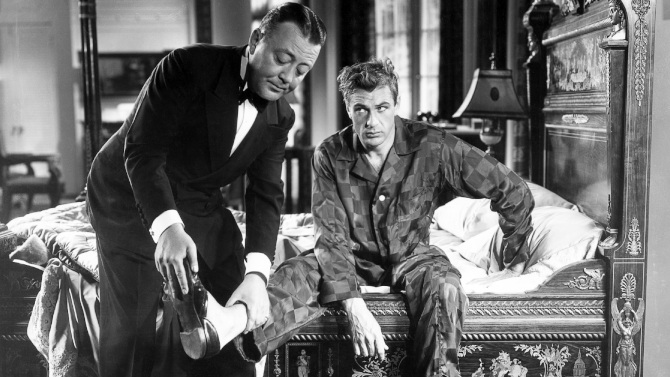
Residing in the beguiling town of Mandrake Falls, Vermont, it just so happens that his rich uncle passes away and leaves him all of his roughly twenty million dollars. . . leading him on a collision course between two very different ways of life.
With some snake oil salesmen lawyers coming down to tell him the news and transport him back to New York City, John Cedar (Douglass Dumbrille – The Cat Creeps; Abbott and Costello in the Foreign Legion) is their illicit leader, and he’s keen to hoodwink the supposedly gullible new millionaire into signing him on as his power of attorney in order to take control of that ‘burdensome’ money. . . all before Goodfellow realizes he has slowly been bleeding his uncle of his funds by way of some sketchy bookkeeping.

Thankfully, not all of what Cedar does is traitorous though, as he also puts him under the care of Cornelius Cobb (Lionel Stander – Pulp) – a wily and cynical but loyal man who will be tasked with keeping the gossipy newspaper people away from the fresh meat. Yet, one slips through Cobb’s fingers, as cute columnist Louise ‘Babe’ Bennett (Jean Arthur – Only Angels Have Wings) goes undercover as a sympathetic young woman named Mary Dawson who is supposedly down on her luck.
As Longfellow rather quickly gets attached to the woman, she also learns of what a stand-up fella he is. . . and starts to feel guilty of the skewed takes she has been writing for her newspaper. As it becomes ever more clear that he is also not falling for Cedar’s clingy pleas, the desperate attorney has his own corrupt plans. What will come of the newly wealthy small fish that has now been taken from his pond and thrown into the most cutthroat body of water? Also, how can anything good come of Babe starting to fall in love with Goodfellow? And lastly, what dangerous schemes does Cedar have planned next for the good-hearted man?
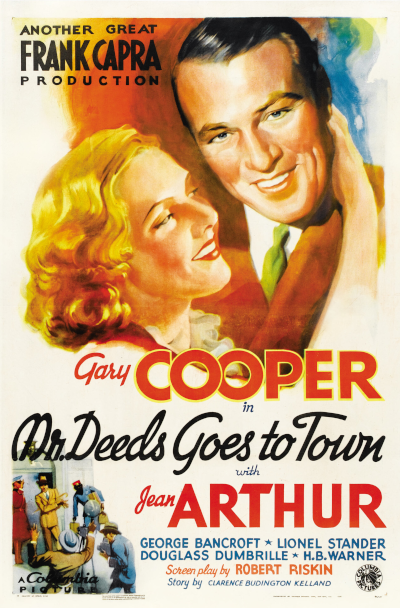
An original Mr. Deeds Goes to Town Style B One Sheet movie poster
Like It Happened One Night, Mr. Smith Goes to Washington, It’s a Wonderful Life, and Capra’s other classics, Mr. Deeds Goes to Town is a sentimental, heartwarming adventure. Meandering through aspects of screwball comedy, romance, as well as copious drama, we see the highs and lows of Mr. Deeds, the charms of small town America, some of the growing flaws of big city life, and the power the good things in life can have against such sardonic attitudes. Certain scenes, like a most sad one that finds our lead’s heart breaking (somehow akin to poor Ralph Wiggum when Lisa Simpson says some most heinous things), truly tug at our emotions, while the conclusion does the same, but in a wholly different and more positive way.
A charming gem that truly transcends the harsh times in which it was made, Mr. Deeds Goes to Town is just another example of Frank Capra’s most precious form of corn. . . a pastiche that features the snappy fast talking dialogue found in screwball comedies, a warmth of cinematic vision, and many memorable moments found from beginning to end. Not only was it the huge success at the box office mentioned above, but it also brought Frank Capra his second Academy Award for Best Director just two years after his first. Also, perhaps one of the most bewitching aspects of this movie found screenwriter Robert Riskin developing the word ‘doodle’ to describe scribbling little swirls and drawings on a page – wow! And, funnily enough, though it almost seems hard to believe, Adam Sandler’s Mr. Deeds (2002) is a loose remake of this. So, discover why Mr. Deeds is a jolly good fellow in this fantastic motion picture. . . it’s only sane to fall in love with this one.