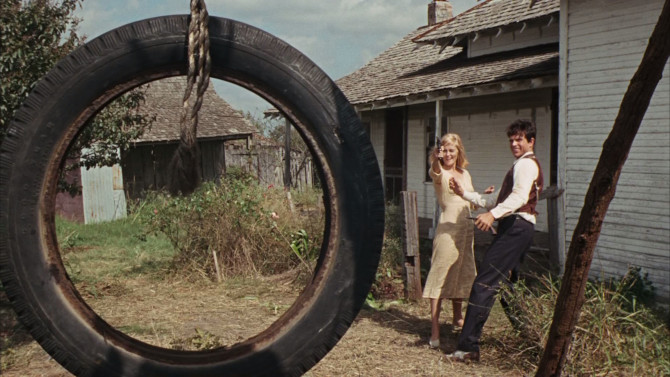


Clyde Barrow: “This here’s Miss Bonnie Parker. I’m Clyde Barrow. We rob banks.”
One of the major films to challenge the Hays Code before it finally failed in 1968 (to be replaced with our modern rating system) was also one of the first to usher in what is called New Hollywood (putting an end to the traditional Hollywood System), namely, the biographical crime drama Bonnie and Clyde (1967), directed by Arthur Penn.
Based upon the real life bank robbers, Bonnie Parker (Faye Dunaway) is a bored amateur poet and waitress in her early twenties looking for any adventure to come her way during the crippling Great Depression. . . Clyde Barrow (Warren Beatty – McCabe & Mrs. Miller) just so happens to be a recently released convict that she spots and becomes infatuated with.
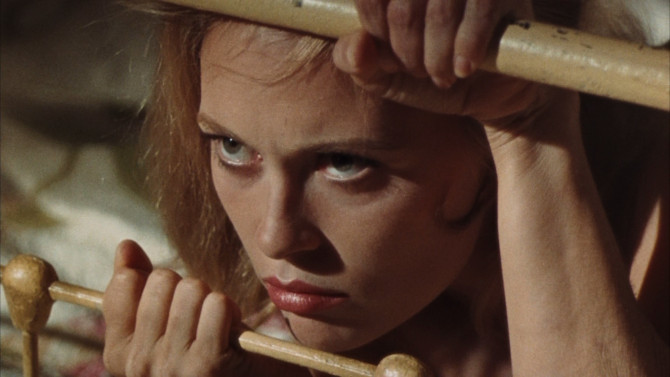
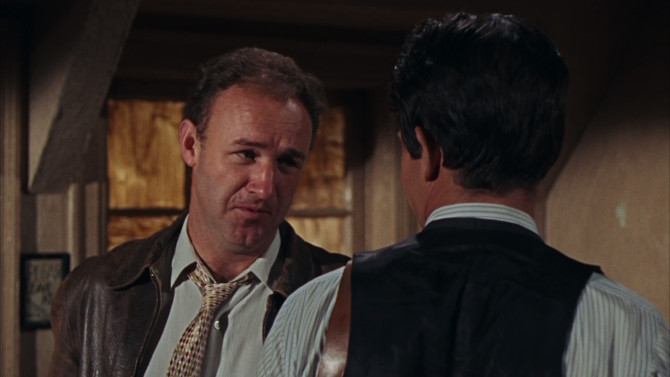
With no money and no real future (after all, a rap sheet and the worst recession ever seen doesn’t help), the anti-establishment pair soon recruit knowledgeable car guy C.W. Moss (Michael J. Pollard – whose character was an amalgam of several of the sidekicks of the infamous pair), also bringing aboard Clyde’s older brother Buck (Gene Hackman – Unforgiven; The Replacements) and his twitchy wife Blanche (Estelle Parsons – the Oscar winner for Best Supporting Actress for this) to form the rest of the team promptly known as the Barrow Gang.
Knocking off banks and stores throughout the southern United States, the gang soon are being chased by every lawman in the south, but are also building up a mythological status amongst the struggling country and city folks in the region – who have become more than frustrated by the establishment. Also, keep an eye out here for a small but memorable role from Gene Wilder – it was in fact the actor’s first movie.
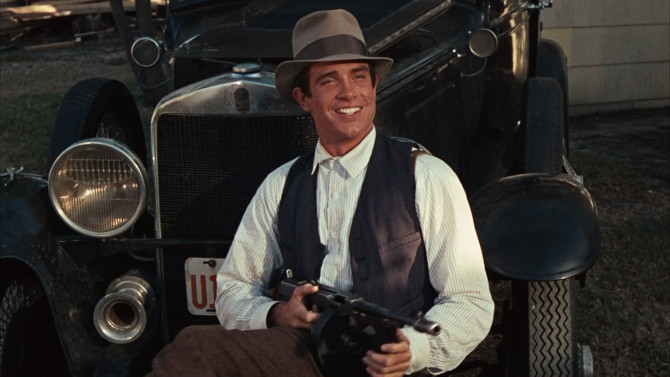
Though Clyde is a crack shot, they are by no means a well organized gang of criminals. . . instead naive in many ways, they are simply flying by the seat of their pants. Can the couple keep eluding the cops while robbing numerous banks? If so, how many casualties will they incur within their beloved group?
Despite meeting some mixed reviews upon release, Bonnie and Clyde’s unique push against the establishment (much like the characters within the movie), caught on during a time while the Vietnam War was dragging on. This counter culture movement looked upon the gang as more sympathetic, rebelling against harsh authority, it echoing a cynicism of the time. . . opening the door for a very different movie that pushed the boundaries of what had been seen for decades under the Hays Code. Violence was more graphic, sexuality was more blunt (including Clyde having some impotency problems), and yet it was all infused with some quirky comedy as well, making for something very new showing in the cinemas. And, just to demonstrate how popular the film became, thousands of berets were sold thanks to Dunaway’s unique look as Bonnie onscreen.
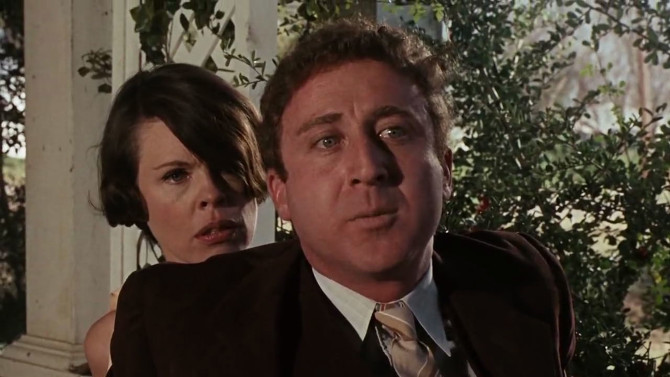
Some of the acting must also be mentioned. Firstly, the juxtaposition between the two women, Bonnie and Estelle, works wonders, Dunaway playing the former more cool and laconic, while Parsons’ high-pitched panic won her the Academy Award. . . yet it also leads to some head butting. The Wilder scene is also memorable, a sequence that flip flops from terror to comedy to terror again in short order after Bonnie learns that he is an undertaker, which brings her a touch too close to contemplating her own demise. Lastly, also look to a rare meeting between Bonnie and Clyde and her mother – a moment that might usually be played as joyous, but instead has a dark, almost funeral-like pallor.
Concluding with a most famous ending, Bonnie and Clyde was a game changer in Hollywood. Though it shows some flaws (it sometimes having loose narrative flow and awkward pacing in its direction), its massive impact is almost immeasurable. Influencing the anti-establishment movement as well as cinematic violence and sexuality, it opened up the landscape of the late 60s (Easy Rider), into the 70s (The Godfather) and beyond. It is also worth highlighting that veteran cinematographer Burnett Guffey, perhaps most famous for winning an Oscar for From Here to Eternity (1953), won his second Academy Award for his work on this picture. And, for a final fun fact, note that Morgan Fairchild’s first acting role was as Faye Dunaway’s body double here – actually, she did much of the driving as she knew how to drive stick-shift and Dunaway didn’t. So, join the Barrow gang for this shoot-em-up classic, this isn’t a trap.