
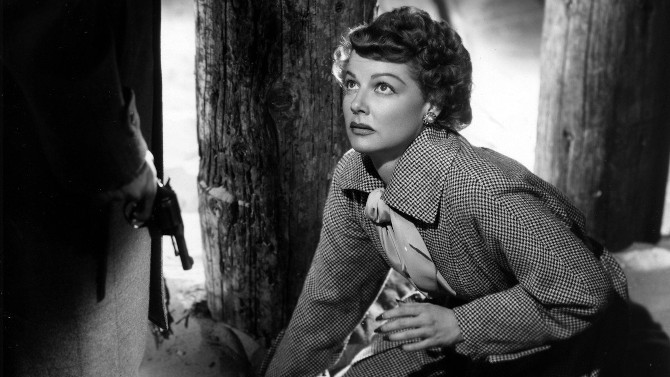


Inspector Ferris: “Say, did he ever do a self-portrait?”
Eleanor Johnson: “He didn’t like himself that much.”
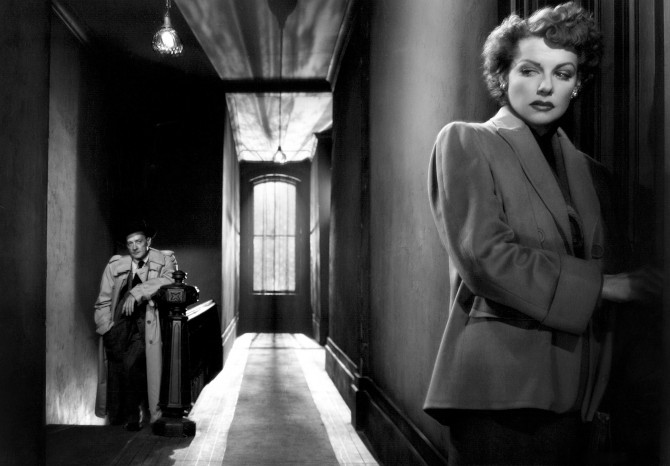
In 1955, Frank Sinatra used to sing that “love and marriage go together like a horse and carriage”, though the film noir today, titled Woman on the Run, which was released five years earlier in 1950, takes a wholly different look at the topic. . . centred upon an up and down, topsy turvy roller coaster ride of a relationship – which, of course, has its climax ending at an amusement park that, you guessed it, features a roller coaster.
It only seems fitting then that one of its screen writers, Alan Campbell, had his own tumultuous relationship with his wife Dorothy Parker (they formed a popular writing team together), while the feature’s director, Norman Foster (Kiss the Blood Off my Hands; and a protégé of Orson Welles), also had his fair share of problems when he married Claudette Colbert. . . in other words, two complicated relationships that probably influenced this movie and its themes.
Co-produced by star Ann Sheridan, she helped choose Foster as the director, while also aiding with some of the casting. . . too bad it wasn’t a box office success, as she took much of the blame.
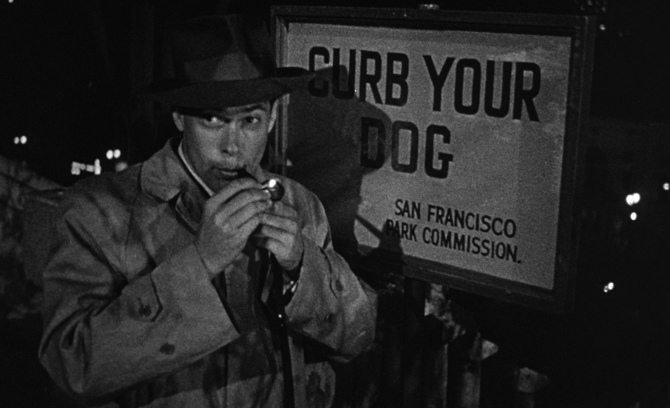
A story that starts off with a bang, the unhappily married artist Frank Johnson (Ross Elliott), who has a bad heart, is walking his dog late at night in San Francisco when he stumbles upon a murder in progress. . . after shots are fired at him too (hitting his shadow instead), he disappears from the cops, preferring to take his chances hiding out around town rather than being the key witness in a mob killing.
With Inspector Ferris (Robert Keith) having no one else to latch onto, he hopes to use Johnson’s disgruntled wife Eleanor (Sheridan) to track him down. . . but, as the title suggests, she too would prefer to be a woman on the run. Finding ways to sneak out of her house and lose her tails, the only person she isn’t seemingly able to avoid is rags reporter Dan Legget (Dennis O’Keefe).
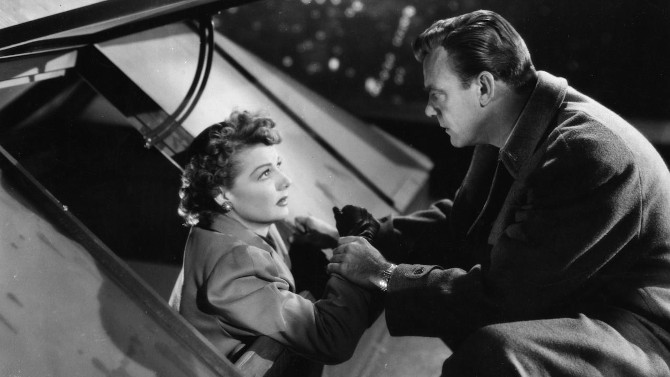
Offering her big money for her husband’s story, she is happy to team up with him over the cops, the pair forced to follow certain breadcrumbs left behind for Eleanor so that she can find him before anyone else. Traveling throughout San Francisco to track him down, is Legget on the up and up? Either way, will Eleanor be able to find her on-the-lam husband?
Rather emblematic of many a relationship after World War II, as husbands were returning home after years away from their significant others, they had to reconnect with them and sometimes discovered that their husband or wife wasn’t the same person. With the Johnson’s in a similar type of conundrum, we never actually see what went wrong, instead mostly getting her fractured side of the story. Intriguingly, the longer the search for her husband, the more she starts to realize that he is still in love with her (for instance, the mannequins he creates at work all look like her) and she starts to feel the same way. . . learning many things that she never even knew about him.
Shot throughout the striking city of San Francisco, it gives a more edgy view of the locales compared to the picturesque places in a movie like Vertigo, taking the viewers through spots like Chinatown, used clothing stores along the waterfront, the harbor. . . though we do also get some beautiful views of the Bay, City Hall, and other such places.
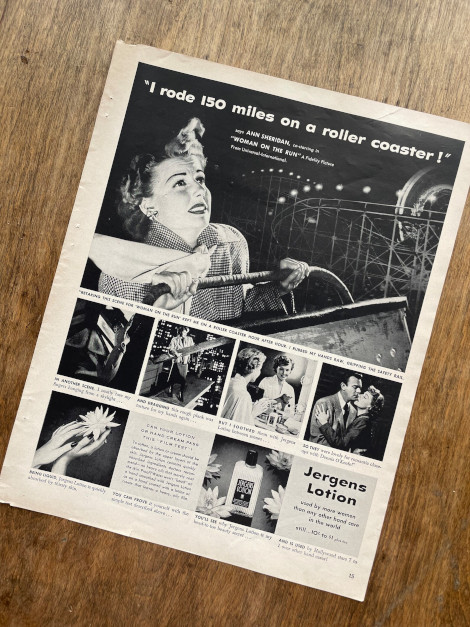
Finishing up at Ocean Park Pier in Santa Monica (which was used instead of San Fran’s own amusement park due to its waterside placement that was needed for the script), funnily enough, despite co-producing, Sheridan had to ride the roller coaster. . . a real fear of hers. Though much of the scenes weren’t done on the actual coaster, she did have to do it a few times, much to her chagrin (though they were clearly proud of this element, as advertising was used from these sequences, not only on the original movie posters, but even in a Jergens Lotion advertisement predominately featuring Ann Sheridan doing many stunts that had her using the product to recover – including the roller coaster).
With beautiful visuals and lighting, Woman on the Run might be missing some film noir elements that people often look for, but it does thrive in its other noirish aspects. . . like its snappy hard boiled dialogue, the rough around the edges urban decay of some of San Francisco, a quirky play on the femme fatale that could instead be named a homme fatale, and those post-war alienation/disillusionment elements. The score, written by Arthur Lange and Emil Newman, must also be mentioned, as it is not only emblematic of these classic gritty elements, but also uses some dynamic diegetic sound as Eleanor does a late night search for her husband – the music becoming what is actually heard by her as she attends jazzy nightclubs (for instance, an Asian influenced song playing at a place in Chinatown, or the carnival tunes repeating at the end). So, pay attention to the lighters as you watch this one, they’ll show you the right path.