


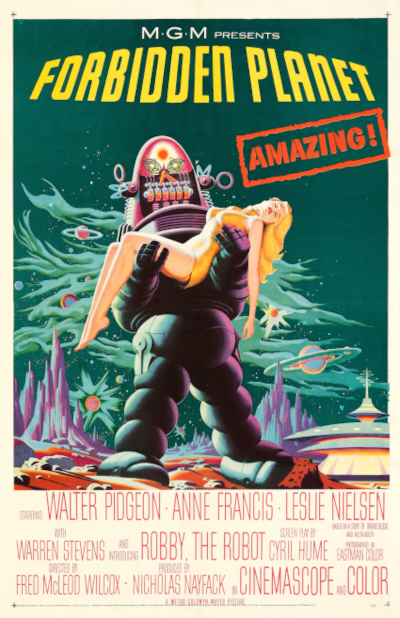
An original US one sheet movie poster for Forbidden Planet
Commander Adams: “We’re all part monsters in our subconscious! So we have laws and religion.”
Though today’s feature is immediately sited as a science fiction classic, Fred M. Wilcox’s Forbidden Planet (1956) is perhaps just as well remembered for its majestic original robot and pinup infused movie poster design (that is still, to this day, a costly collectible). . . though the art is quite misleading when you know what the movie is actually about.
Following a narrative loosely inspired by William Shakespeare’s “The Tempest”, which, for those who do not know, is about a man forced to live stranded upon a magical island with his daughter, until he causes a shipwreck that brings with it possible rescue (and a man who may fall in love with his daughter). . . this futuristic feature follows a somewhat similar sci-fi blueprint.
Set in the 23rd century, the United Planets have sent out a spaceship to search for a lost crew that were exploring the Earth-like planet Altair IV – as nothing has been heard from them for some twenty years. Led by bold Commander Adams (Leslie Nielsen – Airplane!), as well as second in commands Lt. Farmer (Jack Kelly) and Lt. ‘Doc’ Ostrow (Warren Stevens), as they enter the planet’s orbit, they are shocked to hear the voice of one of the lost crew, Dr. Morbius (Walter Pidgeon – How Green Was My Valley), warning them to land at their own peril.
Landing anyways (after all, this is their whole mission), upon meeting up with the missing doctor, they learn that the rest of his crew mysteriously died not long after their arrival. Living on the planet with only his innocent daughter Altaira (Anne Francis – The Love God?) and useful robot Robby (one of the most famous robots in film history), he has spent the last two decades exploring the technology of the long deceased ultra intelligent race that used to inhabit the place.
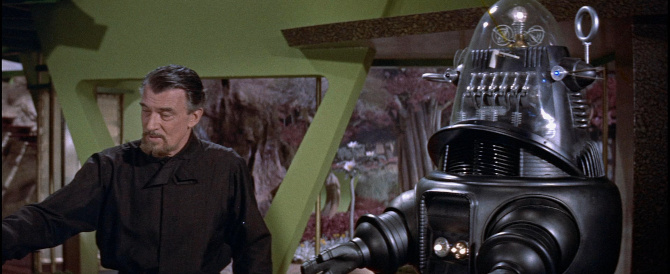
Utterly impressive, but also very dangerous in its possible applications, perhaps the safest thing Dr. Morbius has learned is how to create Robby, while he also reveals that some invisible creature ripped the rest of his crew apart limb from limb (hence the peril). Needing to report back to his superiors before being able to leave, Commander Adams also tries to learn more about the mysterious hidden technology.
Yet soon, the Commander’s crew also start to be slaughtered. Will he be able to touch base with his superiors before any more casualties occur? Also, will he be able to glean any more information from the reclusive doctor? Is it possible that the Commander or any of his men might be lucky enough to win the heart of the pure young lady? And, what could this invisible monster actually be?
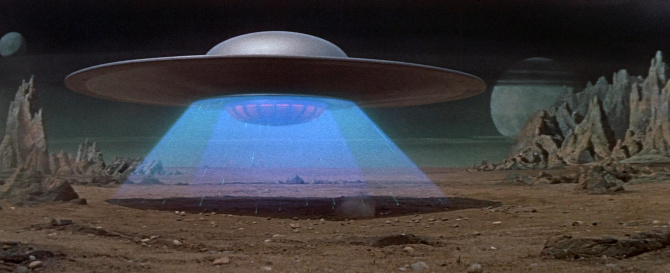
In an era of B-movie sci-fi cinema, this was one of the first attempts to explore space in a more grounded and expensive A-movie light (six years later, Robinson Crusoe on Mars would be another example). Instead of giant bugs, and cheesy killer robots, and little green aliens, oh my, this aims at being more science and psychology based. With it being the genesis for Gene Roddenberry’s original Star Trek, as well as the basis for a lot of Star Wars roots (think holographic messages, C-3PO being a bit like Robby, its electronic sounds, and use of ‘blasters’), there is no denying that almost everything in sci-fi cinema and television evolves from Forbidden Planet.
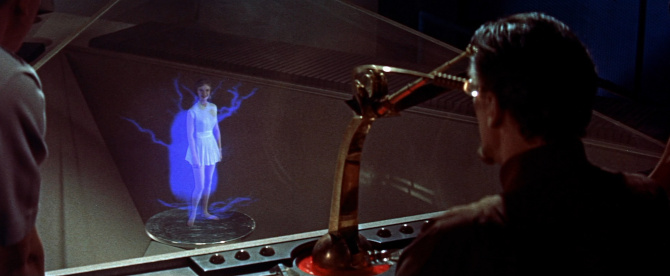
It must also be noted that this motion picture was very much influenced by the works of Sigmund Freud. Never truly seeing what the original alien species or the monster on the planet really looks like, it is best described as a crude, cruel, and unconscious component of the mind, or as he would have called it, the ID. In fact, much of the rest of the story is also influenced by Freud’s work, for all the lonesome men are almost primitively drawn to Altaira, while it could also be argued that Morbius’ relationship with his daughter could fall under a form of the Oedipus complex.
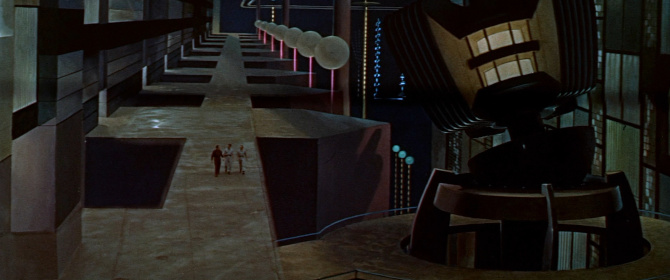
Featuring a cool futuristic setting, unique performances, memorable special effects, the first original electronic score (by Bebe and Louis Barron), kitschy cool costume design (especially Altaira’s glamorous and rare miniskirts for the time), and so much more, Forbidden Planet is a memorable gem from the 1950s. With a scope and scale that feels so real (thanks to its combination of massive sets, matte paintings, use of miniatures, and other old school effects), the planet and its giant alien artifacts feel almost authentically surreal in their grandeur. Lastly, it is also worth mentioning that there are actually quite a few comedic bits in this one. . . many of which surround the ship’s aptly named alcoholic chef, Cook (Earl Holliman). So, explore this forbidden planet, it’s full of monstrous secrets and explosions.