


Elinor St. John: “. . . A child born in 50 years will stumble across your image flickering on a screen and feel he knows you, like. . . like a friend, though you breathed your last before he breathed his first. You’ve been given a gift. Be grateful. Your time today is through, but you’ll spend eternity with angels and ghosts.”
Sometimes, certain films just seem destined to underperform at the box office, only to fall into more of a cult status down the road. . . and this could likely be the case for writer/director Damien Chazelle’s epic depiction of late 1920s, early 1930s Hollywood in Babylon (2022).
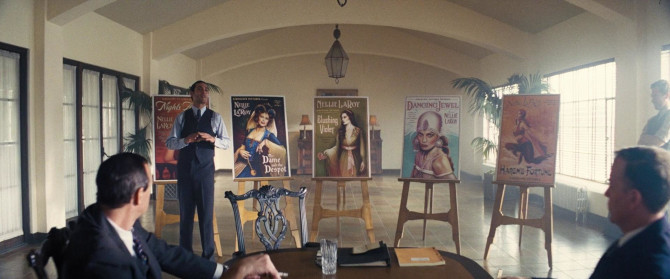
Clocking in at three hours, nine minutes, if Chazelle’s 2016 musical La La Land was a love letter to current Hollywood, then this could easily be considered something similar to the growth and birth of the place. In some ways reminiscent of Quentin Tarantino’s 2019 feature Once Upon a Time… in Hollywood (which also gives the viewer a bird’s-eye view into the movie making business), the aptly named Babylon is perhaps not for the faint of heart, but will be rewarding for anyone intrigued by the silent and the 30s Pre-Code era (or for people who are simply looking to learn more about this cinematic time).
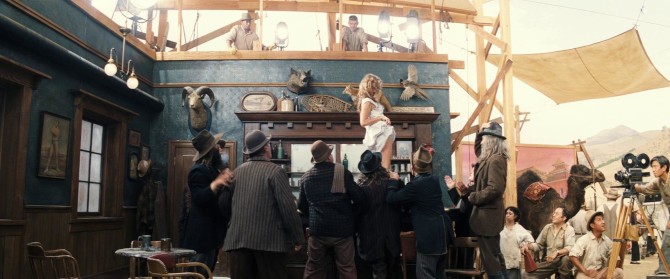
Intriguingly, Babylon mostly tells a story spanning from 1926 to 1932, starting its frenetic pace with the final years of the silent movie era. A place that draws anyone desperate to follow a dream, at this time Hollywood is a wild west of sorts, feeling like a lawless haven that has let unbridled freedom run rampant. A place where elephants can be imported for parties, movies can be made without permits – where an unregulated style of guerilla film making can be done throughout the desert, while both nights and days can be filled with sex, drugs, and the era’s form of rock `n roll – jazz.
As time passes and the invention of sound – specifically 1927’s The Jazz Singer, floors the silent movie world, things most certainly will change forever. That extravagant, excessive Roaring Twenties decade will make way for the sensitivity of the microphones and the focus on dialogued performances – which need a new focus and controlled environment.
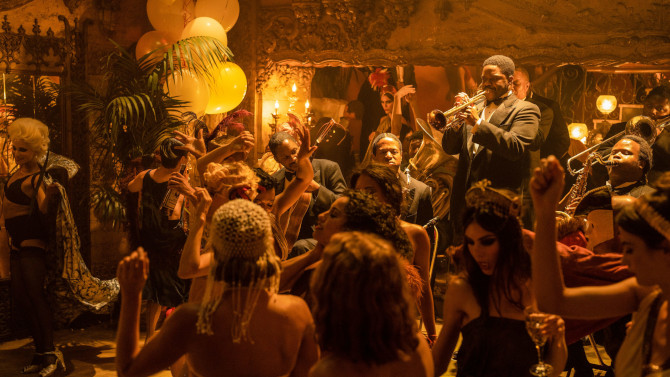
It could be argued that the change in time is being told by way of the four different parties that are layered throughout the picture, with the 1926 opening being a twenty minute debaucherous all-nighter in the Hills where the excesses run high (look into the infamous Fatty Arbuckle party for the partial influence for this sequence). It uses long takes, dynamic pans, and so much more to capture the chaotic hedonism of the night. Followed by a slightly more demure party about three years later, it still brings the craziness (as it ends with a barbarous human versus rattlesnake fight), but you can see that some of the Babylonian behaviour does not fit in the same way as business is slowly taking over. Flash forward to the early 1930s, where a posh mansion party has turned things snobbish, the cash and profits having cleaned up the freedom that once was, which has now gone underground – the fourth secret location shindig a daunting, scary doozy.
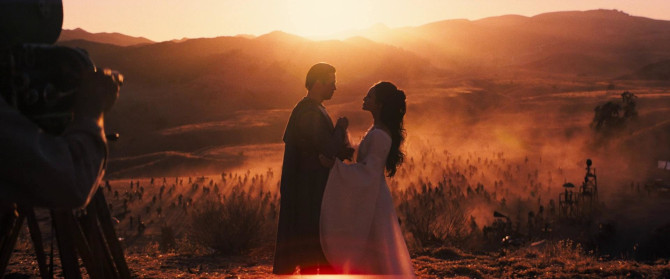
It is in this landscape that we see the rise and fall of our main characters. Silent film star Jack Conrad (Brad Pitt) – think Douglas Fairbanks, Rudolph Valentino and the now lesser known John Gilbert, loves the business, as well as being serially married. . . bouncing from Ina (Olivia Wilde), to Hungarian Olga (Karolina Szymczak), and then Broadway star Estelle (Katherine Waterston). Burning the candle at both ends, he works hard and plays harder, though will struggle to transition into talkies. Then there’s Nellie LaRoy (Margot Robbie) – inspired by ‘It Girl’ Clara Bow, who gains fame at the end of the silent era thanks to that je ne sais quoi quality, but could also struggle in the transition due to her Jersey accent. Waiter Manny Torres (Diego Calva) is also desperate to work his way up the industry, another willing to play the dangerous game. Meanwhile, musician Sidney Palmer (Jovan Adepo) – think Louis Armstrong and many others, gets swept up into the movie world as the sound design expands, but will the African American be able to live that life? And lastly, Lady Fay Zhu (Li Jun Li) – probably most closely related to first Chinese-American star Anna May Wong, a lesbian, similarly works in the industry, but struggles as things get more restrictive in the 1930s. It is also worth noting that gossip writer Elinor St. John (Jean Smart) flits around the edges, both an aid and a danger to every star depending on their popularity at the time.

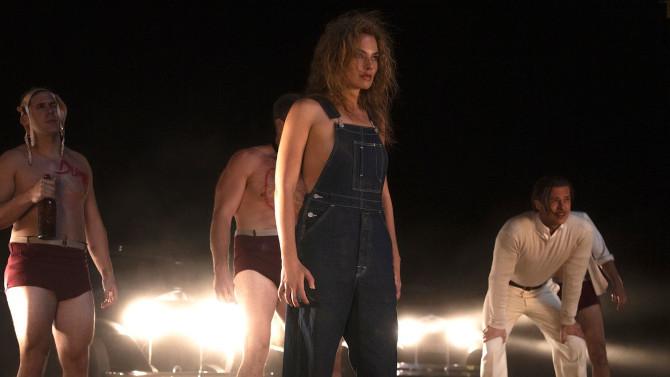
Some might watch this and find much of it incredulous and unbelievable, but it might be shocking to some to find out that it is mostly all rooted in reality. For instance, much like the reference to the Fatty Arbuckle party scandal above, other actual examples saw extras dying on set (see information on the 1928 feature Noah’s Ark for the tragic list of deaths and injuries – which is just one example), a similar sexy pair of overalls on Margot Robbie being worn by both Clara Bow (in 1926’s The Runaway) and Bessie Love (see a small still of the infamous photo to your right, believed to be taken in either 1921 or 22), as well as Nellie LaRoy’s first talkie pulling direct inspiration from the above mentioned Bow’s The Wild Party (1929) – which was in fact directed by an early female triumph – Dorothy Arzner. Of course, there are other stories as well – like the icing of nipples between takes being a Jean Harlow thing, but I’ll leave it there.
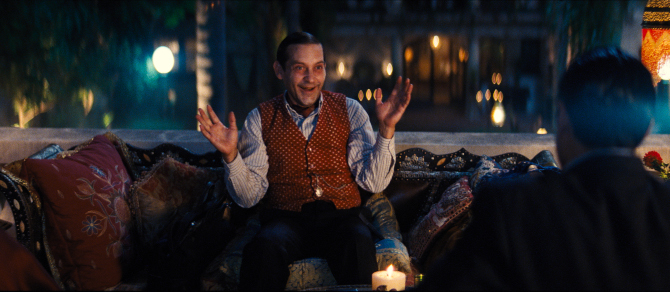
A slick, stylish (unbelievable set and costume design), and energetic exploration of Hollywood’s distant past, Babylon rightfully pushes the envelope to give its viewers a dynamic vision of what the time was like (which has made it divisive – which seems about right for the topic). At the same time, there are crazy moments of comedy, and perhaps even more importantly, powerful tinges of melancholy for the loss of a bygone era – feeling a bit like Rutger Hauer’s emotional soliloquy from Blade Runner – here’s just an excerpt: “All those. . . moments. . . will be lost in time, like tears. . . in . . . rain.” The score is also impressive, with Chazelle regular Justin Hurwitz bringing the same energy to the piece (listen closely and you’ll hear some connections to his previously written La La Land). It also shot in as many locations that still exist from this period as well, which adds nice authenticity to it. Also, keep an eye out for great cameos from Eric Roberts as Nellie’s father, famed Red Hot Chili Peppers’ bassist Flea as a studio executive, Samara Weaving as a pissed off Constance Moore, Tobey Maguire (who also executive produces the movie) as twisted gangster James McKay, and SNL’s Chloe Fineman portraying star Marion Davies. So, help decide if this Babylon from the past will become a future cult classic, for it might just have you Singin’ in the Rain.