
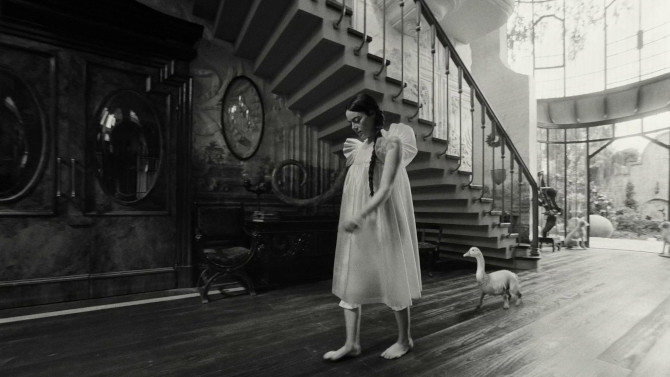


Dr. Godwin Baxter: “My father once told me, ‘Always carve with compassion.’ He was a fucking idiot, but it’s not bad advice.”
Based upon the 1992 novel of the same name by Alasdair Gray, as well as clearly taking some inspiration from Mary Shelley’s “Frankenstein”, Yorgos Lanthimos’ Poor Things (2023) is not the horror path one might expect from the monster book/movie referenced above, instead, it feeling like a coming of age sci-fi fantastical fairy tale that also dabbles in the realm of psychology, romance, drama, and even comedy.
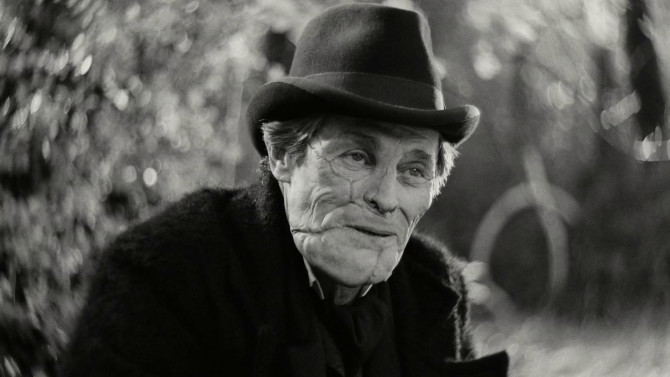
Set in an eccentric world trapped somewhere between Victorian England and some sort of steampunk futuristic alternative, Bella Baxter (Emma Stone – Bugonia; La La Land) is the latest dynamic if out there scientific experiment by the deformed Dr. Godwin Baxter (Willem Dafoe – Nosferatu; The Lighthouse). A grown woman in body, but with the mind of something closer to a baby, it does seem like she is developing at a quicker pace compared to a normal human child.
With the Doctor hiring medical student Max McCandles (Ramy Youssef) to be the full time scientific analyst of Bella, he is to record her every action, from what she does and eats, to how she speaks and develops. Of course, as Max is the first true man outside of her ‘father’ she has met, upon learning of the idea of marriage, she is enamored with the idea in regards to him.
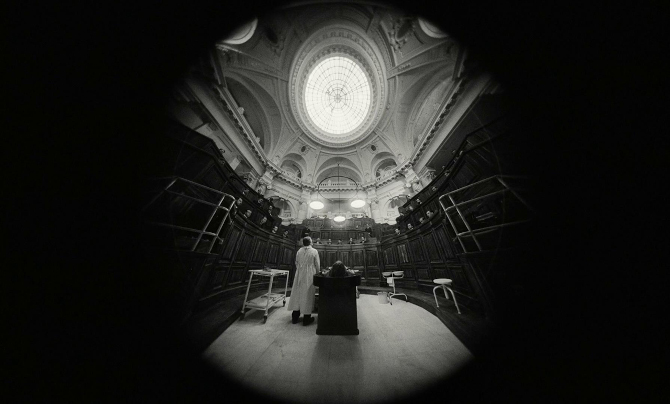
Soon though, it is hard to keep the ever developing Bella cloistered away in the Doctor’s quirky mansion. . . a yearning within her growing to explore the world and all it has to offer – adding a fear in both Godwin and Max that they might lose her.
As her unorthodox curiosity, innocence, and beauty exudes outwards, it also draws nearly every man she meets to her. . . the first being (after McCandles that is) the narcissistic lawyer Duncan Wedderburn (Mark Ruffalo – Avengers: Endgame), a selfish, debaucherous man who capitalizes on her newfound sexual peculiarities.
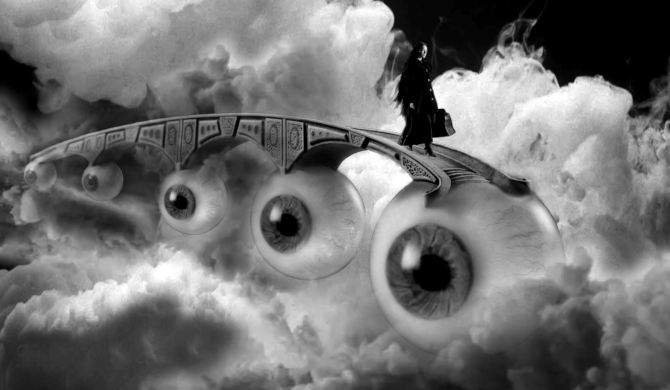
Unable to control her anymore, the men must let her leave, Duncan taking her on a trip to Lisbon and beyond – her first big step into the world. . . a journey that will aid her in discovering the good, bad, and ugly of the humanity on planet Earth. Her combination of youthful naturalness combined with the scientific base Godwin has instilled within her makes for a most dynamic experiment. . . her accelerated education in life with little to no knowledge of societal norms, religious structures, gender behaviours, or typical nurturing giving her the freedom no one else has.
As she continues down her own rabbit hole of self growth, what shall Bella choose to do? Will she become tired of people like Duncan and select some other path? Might she decide to return ‘home’ to the Doctor and her original caretaker in Max? Or could some other unexpected turn in life await her?
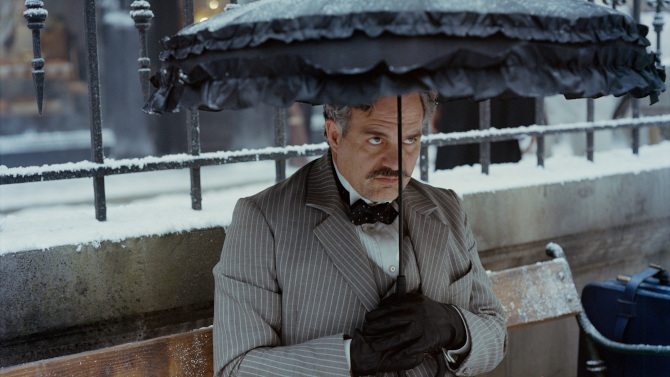
Intriguingly, Bella is not the only childlike creature, as each of the men who she encounters in life is equally as fragile. . . as Dr. Godwin is using his creation to fill a lonely void within him caused by his own scientific upbringing by his warped father; McCandles is a meek submissive in his attitude instead of a grown adult who could be a true romantic partner for Bella; while Duncan’s selfish narcissistic desire to stunt Bella’s own growth instead of helping her evolve into an autonomous human being shows his lack of maturity.
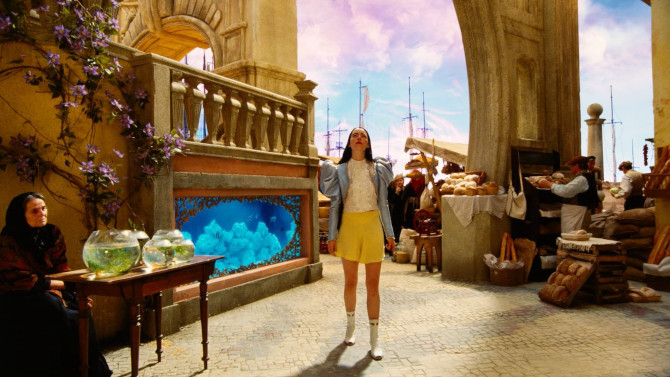
Matched by its exquisite set design, dynamic costumes, and more, the movie mostly starts off as a black and white picture, its scientific nature echoing Bella’s early child-like upbringing locked in a gilded castle. Upon her journey in life, the colour of the world becomes vibrant and almost surreal (an Ektachrome reversal film stock was processed by way of something called an E-6 process). . . Lisbon’s steampunk futuristic aesthetic gives way to the beauty and horrors of Alexandria, the liberal nature of Paris, and back to Victorian London once again.
Always creative, unique, and eccentric, Lanthimos’ Poor Things will draw some comparisons to his own work, especially The Favourite (look for a similar dance scene and a lot of fisheye lens work), while there are a few touches here or there that will also remind viewers of Guillermo del Toro and Robert Eggers . . . but, as always, most of the time Lanthimos’ work is its own special thing that is not akin to any other cinema.
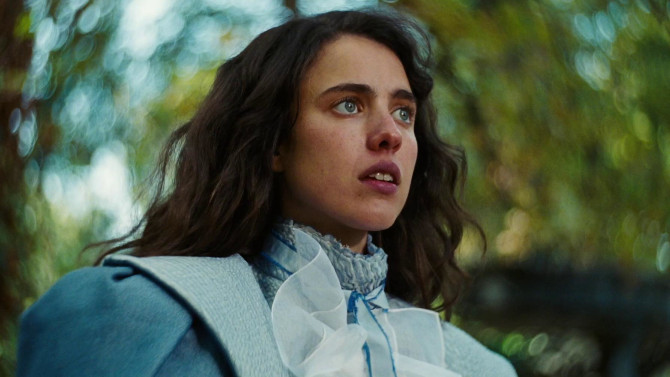
Lanthimos’ most successful movie to date, Poor Things not only grossed close to 120 million dollars at the box office, but also brought home four Academy Awards – Emma Stone for Best Actress in a Leading Role, as well as for Makeup and Hairstyling, Production Design and Costume Design (it also earned seven other nominations, including for Best Picture that year). Both definable yet indefinable in what it truly is, this sexually edgy oddball character driven feature certainly checks numerous boxes if you’re interested in the gothic, old-school horror concepts, unorthodox comedy, peculiar dancing, steampunk aesthetic, or a hodgepodge of the odds and ends of the abnormal. It is also worth noting the score done by Jerskin Fendrix, as it is so abstractly different that it truly stands out in a most vibrant and progressive way. Lastly, watch for a small role from Margaret Qualley as Felicity – another one of Godwin’s scientific experiments. So, discover the past, present, and future with this peculiar picture and decide if it’s the brainy GOAT of eccentric movies.