


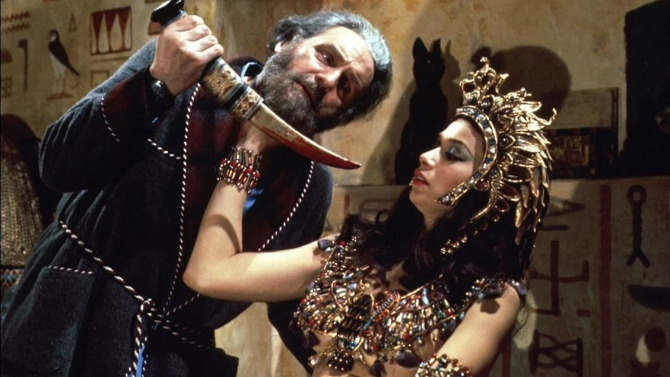
‘What Could Have Been’ is a continuing look into the reels of film history, analysing movies that could have been something special, but due to problems with script, production, budget, or any other type of issue, did not reach its full potential.
Corbeck: “The meek shall NOT inherit the earth. They can’t be trusted with it.”
Sometimes a movie is born under a bad sign, and sometimes it just so happens to be a horror movie (ironic, as this one also has to do with the astronomical alignment of the stars – specifically the big dipper). In 1971, Hammer released Blood from the Mummy’s Tomb. . . which, during its production, lost icon Peter Cushing to his wife getting very ill, its director Seth Holt dying before completion, while Holt was also planning on editing the picture – meaning when he passed, he never left any idea of how the whole thing was going to be put together to create a finished product. After Holt’s passing, Michael Carreras stepped right into the project to finish the directing with Peter Weatherley tasked with editing it all together. All rewrites which were still being done while Holt was directing were cancelled upon his death, which also couldn’t have helped.
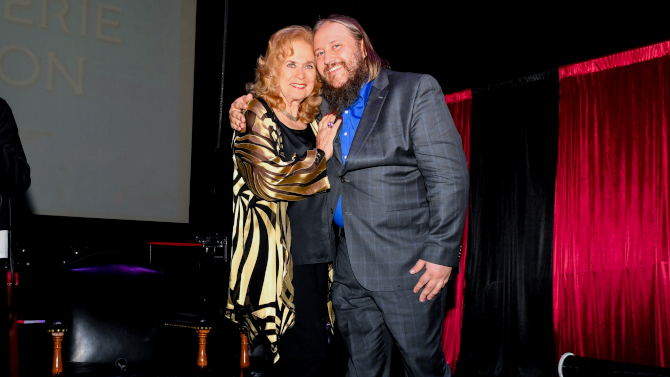
A story based upon Bram Stoker’s less famous horror novel “The Jewel of Seven Stars”, the narrative follows archaeologist Julian Fuchs (Andrew Keir. . . originally to be played by Cushing) and his daughter Margaret (Valerie Leon – Revenge of the Pink Panther; Carry On Girls. . . seen to the right with Filmizon.com’s Nikolai Adams). . . who just so happens to have been born at the exact moment her father discovered an Egyptian mummy named Tera – who has mysteriously never aged a day and is the spitting image of Margaret.
What was an unmarked hidden tomb of a woman who was never to be named (as she was supposedly an evil Egyptian queen), all those who accompanied Julian, including curator Geoffrey Dandridge (Hugh Burden), the now insane Berigan (George Coulouris), and clairvoyant Helen Dickerson (Rosalie Crutchley), agree to superstitiously hide the relics found at her tomb and to keep the one already severed hand separated from the rest of the body. . . except for Eugene Corbeck (James Villiers), who since the discovery is enthralled with resurrecting the preserved ancient.
With Julian still obsessed with the mummy, he recreates her tomb in his basement, frequently observing the long dormant queen resting in her sarcophagus. As all of the celestial stars start to come into the proper order, Julian also makes the mistake of giving his daughter the mummy’s giant ruby ring as a sort of protective gift. . . except as soon as he does so, her dreams become more nightmarish and she develops an odd fascination with her ancient lookalike. . . often in a bizarre illusory state.
Immediately noticed by her boyfriend Tod Browning (Mark Edwards – his character name an homage to the legendary horror director), as well as terrifying all of Julian’s former compatriots, it also soon draws Eugene to her too. . . as he has secretly been watching the family from the house across the street. As the ring, and maybe also the soul of the Egyptian Tera, start to grab a hold of Margaret, what will become of both poor Margaret and the ancient queen hidden in a London basement? Could her powers be ageless, and, if so, might the skulking Eugene help her to resurrect? Or, perhaps one of the superstitious other discoverers could put an end to Tera before it is too late.
With all of the above issues listed earlier on, its lack of clarity does two things, firstly, making things less clear as to what is exactly going on (unlike most other Hammer horror movies), and secondly, makes its obscure eeriness all the more spooky (perhaps because things are less clear). Not looking out of place with the directorial change, the visuals flow despite the obvious disruption and editing questions marks, while the audience is also left to wonder what Cushing would have added to the role of Julian Fuchs (as he only did one day of filming before stepping away from the project). It is safe to say that Andrew Keir seems well suited for the character, despite the fact that they had to re-write some of his story after he fell on set and was left quite injured – you’ll notice he spends a lot of time bedridden in this one for that very reason (just another example of the bad luck related to this feature).
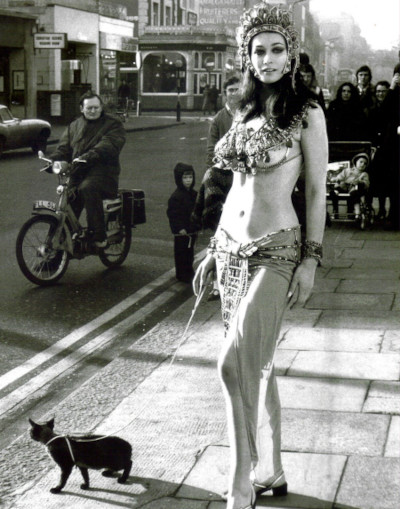
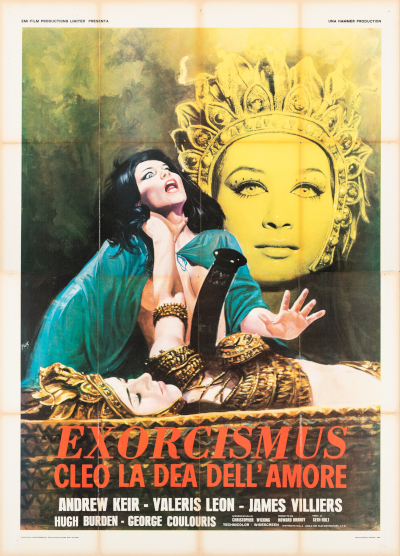
Though not the most structured of Hammer horror movies, Blood from the Mummy’s Tomb still sparkles thanks to its eerie charm, chilling effects (the ever flowing bloody stump of the mummy really standing out), and puzzling Egyptian obscurity. Its open ended finale also makes for a unique conclusion that leaves the audience guessing. Released as the double feature of another Hammer film – Dr. Jekyll and Sister Hyde, it certainly made for an intriguing female driven double header. It is also worth noting that the massive original Italian 4 Fogli (done by Mario De Berardinis), is probably the best poster art for this motion picture worldwide. Lastly, this has one of my favourite promotional photos done for a Hammer feature – with Valerie Leon walking a leashed cat in her full Egyptian garb on King’s Road in Chelsea, London during the middle of the day (utterly brilliant advertising). So, unwrap this shrouded mummy mystery celebrating its 55th anniversary this year, it’s an eye opening horror adventure.