 Films That Matter
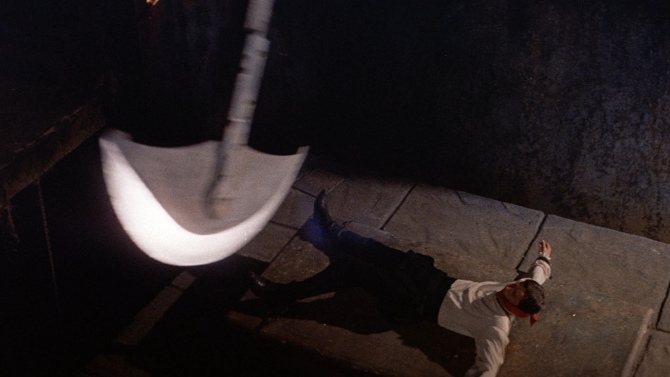
Pit Stop
After Roger Corman’s major success with House of Usher (1960), he promptly turned to adapting another Edgar Allan Poe story to start a franchise of sorts, with The Pit and the Pendulum (1961) being an even bigger win... with it making over two million dollars on a modest budget of only three hundred thousand. Getting Vincent Price (House of Wax; Laura) back after House of Usher’s critical and commercial winnings, this time he plays Nicholas Medina, a tortured soul living in a tomb of a castle with his servants after his gorgeous wife Elizabeth (Barbara Steele – Black Sunday; The Horrible Dr. Hichcock) has seemingly died of a massive heart attack brought on by fright. Feeling as if he is truly cursed, he resides in the same place that his sadistic Spanish Inquisition father once tortured his victims, where his mother and uncle died, and now where his wife has met her untimely end. It has become so bad that even Nicholas’ sister Catherine (Luana Anders) has returned home to try and ease his sorrows.
-

Mountain of Madness
Black Mountain SideDecember 10, 2015There has long been a history of films that deal with isolation and seclusion – some being big budget blockbusters while others are low-budget flicks. Movies such as The Shining, Cabin Fever and The Thing each created a sense of impending dread by using these two themes effectively. The low budget Canadian film Black Mountain Side continues the tradition.
-
Star Pick with Billy Gibbons
 Casablanca on TopCasablancaDecember 17, 2014
We are now in the middle of the awards season and are closing in on the holy grail of film festivities: the Academy Awards, or as we all like to call him – Oscar. This month, I will be reviewing four motion pictures that have won at least one of the major prizes of either best director, actor, actress or picture.
-

Film Noir, De Palma Style
Femme FataleMay 11, 2014In 2002, writer/director Brian De Palma once again put pen to paper and created another one of his unique homages to classic cinema (the first in ten years). Titled Femme Fatale, the director lets us follow his own take on the legendary film noir bad girls of old.
-

What to Get the Man Who has Everything
The GameMarch 28, 2014Before I refer to the main title, I must first announce that long-time character actor James Rebhorn passed away last week at the age of 65. Though perhaps not a household name, the tall balding man (who looked the same age for as long as I can remember) will surely be missed, as he played small yet memorable roles for more than 30 years.
-

The Tramp Finds his Voice
The Great DictatorMarch 13, 2014In 1939, it was known that Charlie Chaplin was making a new film.
-

Westerns, Eastwood Style
High Plains DrifterMarch 10, 2014It is hard to believe that Clint Eastwood has been directing movies for over four decades. His second directorial effort, the 1973 western High Plains Drifter, is now celebrating its 40th year.
