 Films That Matter
Pit Stop
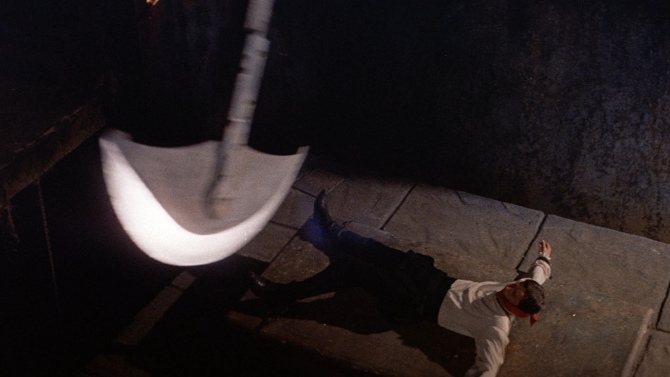
After Roger Corman’s major success with House of Usher (1960), he promptly turned to adapting another Edgar Allan Poe story to start a franchise of sorts, with The Pit and the Pendulum (1961) being an even bigger win... with it making over two million dollars on a modest budget of only three hundred thousand. Getting Vincent Price (House of Wax; Laura) back after House of Usher’s critical and commercial winnings, this time he plays Nicholas Medina, a tortured soul living in a tomb of a castle with his servants after his gorgeous wife Elizabeth (Barbara Steele – Black Sunday; The Horrible Dr. Hichcock) has seemingly died of a massive heart attack brought on by fright. Feeling as if he is truly cursed, he resides in the same place that his sadistic Spanish Inquisition father once tortured his victims, where his mother and uncle died, and now where his wife has met her untimely end. It has become so bad that even Nicholas’ sister Catherine (Luana Anders) has returned home to try and ease his sorrows.
-

Full Throttle
Runaway TrainAugust 31, 2025Opening with infinite possibilities, today’s feature could have been a prison set boxing movie, a searing drama about the conditions in an Alaskan jail, or simply a prison break narrative, but instead, it becomes... Runaway Train (1985). A movie that has become a bit forgotten over time (after its initial disappointment at the box office), director Andrei Konchalovsky’s action thriller follows a rough around the edges bank robber, Manny (Jon Voight) – who has attempted to break out of Stonehaven Maximum Security Prison in Alaska several times. A sort of hero figure amongst the rowdy inmates, the obsessive Warden, Ranken (John P. Ryan), has locked him away in solitary confinement for a most punishing three years.
-

An Attaché Case
Black BagMarch 18, 2025In 2025, dare I say that it’s nice to be highlighting a film made for mature audiences. Avoiding the pratfalls of sequels, remakes, comic book movies, and overly costly bombast, Black Bag, written by David Koepp (Mission: Impossible) and directed by Steven Soderbergh (Traffic), is most easily described as an old school spycraft feature. Opening with an extended tracking shot of spy George Woodhouse (Michael Fassbender) making his way through a happening nightclub in London, his contact soon informs him that there is a rat leaking some sort of tech software named Severus from within the agency. If there is one thing Woodhouse despises, it’s a liar, so he invites all of the suspects to a dinner party to try to get to the bottom of it.
-
Safety First
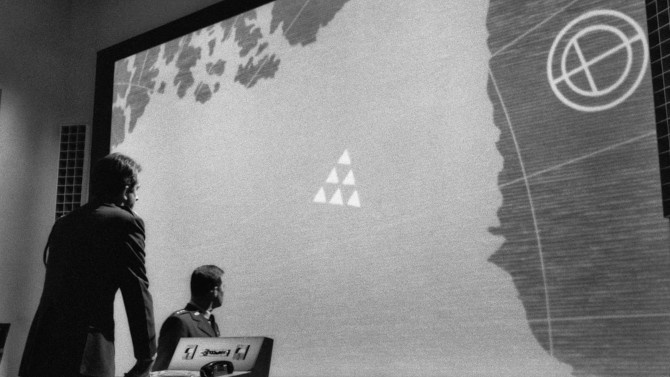
Fail SafeMarch 2, 2025Like a severe and utterly serious version of Stanley Kubrick’s 1964 satirical dark comedy Dr. Strangelove or: How I Learned to Stop Worrying and Love the Bomb, you would think that Fail Safe would have been the original release in theatres that was then later spoofed, yet that is not the case. Released approximately six months later in the same year, as you might imagine, it led to very poor returns at the box office – dare I say it (as the film deals with this subject matter)... it was a bomb! Despite that, over time, it has become a bonafide classic. Based upon Eugene Burdick’s 1962 novel of the same name and directed by Sidney Lumet (Dog Day Afternoon), he introduces us to our main players by way of little vignettes.
-
Star Pick with Kurt Angle
 The Right AngleRockyJanuary 1, 2025
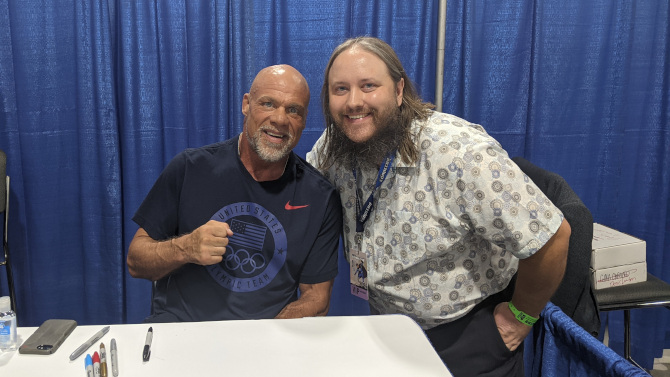
It was an absolute pleasure to meet and get a quick interview with the great Kurt Angle this past summer in Ottawa. First making a name for himself on the amateur wrestling circuit, it all culminated with a gold medal win (with a broken neck, no less) at the 1996 Summer Olympics held in Atlanta, Georgia. The ultimate achievement for most amateur athletes, this was not the end for Angle, but only the beginning. Just a mere two years later, he had signed on to the World Wrestling Federation (now the WWE or World Wresting Entertainment), a leap that would soon find him taking professional wrestling by storm. Making his television debut in November of 1999, he was a natural, not only at the wrestling, but also on the mike.
-
Night Terrors
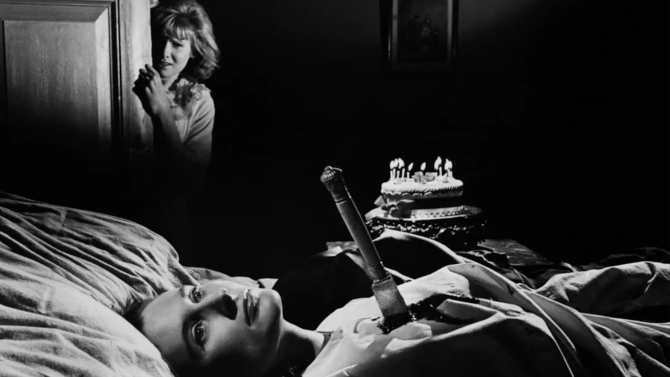
NightmareOctober 17, 2024Unlike most other memorable Hammer horror movies, the 1964 mystery thriller Nightmare, directed by Freddie Francis (perhaps better known as the cinematographer of films like David Lynch’s The Elephant Man and Martin Scorsese’s Cape Fear) eliminates all of the monsters for an old fashioned quasi ghost story... the piece deserving to be remembered up there with those Hammer horror films centered on vampires, resurrected corpses, and lycanthropes. Shot in shadowy black and white, the story follows struggling seventeen year old Janet (Jennie Linden), who is currently away from home living at a finishing school for girls.
-

Eternity Box
Creep BoxJanuary 22, 2024An Indie sci-fi film on the precipice of where we might be heading, Creep Box, written and directed by Patrick Biesemans (and based upon his own short from 2022), ruminates on a hybrid artificial intelligence that is both intriguing and terrifying. Following Caul (Geoffrey Cantor), a PHD in psychology and parapsychology at HDTH Corp, he is currently working on a sleek black tech box... a device that can be used to collect the memories of the dead, which are then fused with an A.I. that can utilize the past of the deceased to not only communicate with loved ones, but also gather information that could lead to solving crimes of those who have been murdered.