 Films That Matter
Pit Stop
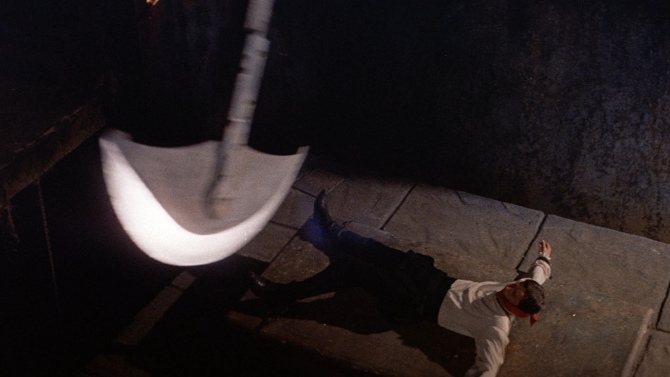
After Roger Corman’s major success with House of Usher (1960), he promptly turned to adapting another Edgar Allan Poe story to start a franchise of sorts, with The Pit and the Pendulum (1961) being an even bigger win... with it making over two million dollars on a modest budget of only three hundred thousand. Getting Vincent Price (House of Wax; Laura) back after House of Usher’s critical and commercial winnings, this time he plays Nicholas Medina, a tortured soul living in a tomb of a castle with his servants after his gorgeous wife Elizabeth (Barbara Steele – Black Sunday; The Horrible Dr. Hichcock) has seemingly died of a massive heart attack brought on by fright. Feeling as if he is truly cursed, he resides in the same place that his sadistic Spanish Inquisition father once tortured his victims, where his mother and uncle died, and now where his wife has met her untimely end. It has become so bad that even Nicholas’ sister Catherine (Luana Anders) has returned home to try and ease his sorrows.
-
Star Pick with Chris Slade
 Classic Western EnsnaresThe Magnificent SevenSeptember 20, 2016
With the remake of the 1960 classic The Magnificent Seven coming out this week, I thought that it would be a good time to go back and revisit the original motion picture – though perhaps some will be surprised to find out that The Magnificent Seven is a remake of Akira Kurosawa’s iconic Japanese movie Seven Samurai. A while back, I was fortunate enough to chat with Chris Slade, the current drummer of AC/DC (who also performed with them during the years 1989 to 1994 – recording three albums with the high octane rock band: The Razors Edge, Live at Donington and AC/DC Live). Born in Wales, the percussionist has had a long and illustrious career, being the original drummer for fellow Welshman Tom Jones (and part of his first six records), as well as being a founding member of Manfred Mann’s Earth Band (recording eight albums along with Manfred Mann, Mick Rogers and Colin Pattenden from 1971 to 1978).
-

A Barrel of Bloody Laughs
Lock, Stock and Two Smoking BarrelsSeptember 18, 2016Numerous robberies, black market sales, an underground high stakes poker game, and traffic violations abound in Guy Richie’s first motion picture – Lock, Stock and Two Smoking Barrels. Featuring the now iconic director’s signature style, Richie fills his intricately plotted, multifaceted storyline with fast paced editing, even faster paced dialogue, his oddball sense of humour, rich personas, and eye-catching style that consists of both sepia tones as well as vivid colours. Though the tale consists of many varied characters, Eddy (Nick Moran), Tom (Jason Flemyng), Soap (Dexter Fletcher) and Bacon (Jason Statham) make up the main gang. They are a group of friends that have been together since childhood and have been small time crooks for nearly as long.
-
Star Pick with Sean Astin
 I Love L.A. . . . ConfidentialL.A. ConfidentialSeptember 13, 2016
A few months back, I was fortunate enough to speak with Sean Astin. For those of you who have been living under a rock for the past three decades, Astin has starred in a plethora of memorable classics. With his mother being the late Patty Duke (Oscar winner – The Miracle Worker), he had large shoes to fill. Starting off with a bang, Astin, in his early teenage years, took on the role of Mikey in Richard Donner’s 1985 fantasy flick The Goonies. Following this, he has continued making wonderful motion pictures, including 1993's Rudy, 1998's Bulworth, as well as playing the beloved role of Samwise Gamgee in Peter Jackson’s The Lord of the Rings trilogy. He also showed off his comedic talents in 2004's 50 First Dates and 2006's Click. He has also conquered the television world, portraying Lynn McGill in ‘Day 5’ of 24 (a very strong season), as well as Jim Kent in Guillermo del Toro’s The Strain.
-
Star Pick with Felix Silla
 Great Things Come in Small PackagesHigh NoonSeptember 6, 2016
While at Trekonderoga on August 13th, 2016, the Ticonderoga, NY, comic con that is all things Star Trek (including the brilliant recreation of the original Starship Enterprise) , I was lucky enough to be able to interview several interesting actors – one of whom was Felix Silla, a man who has left an indelible yet oft hidden mark on the television and film industry over his five plus decades of work. Before I begin, I would like to thank the Trekonderoga staff for setting me up in such a wonderful (noise free) room for my interviews, with a beautiful background of the hilly, forested Adirondacks that frame the excellent three day event. The man behind the mask (or hair), was born in Italy in 1937, eventually making his way to the United States on November 24th, 1955, where the trained circus performer toured with the iconic Ringling Bros. circus (for seven years) and the Barnum & Bailey Show. Using his 3' 11" versatile frame to his advantage, he eventually made his way into show business in the early 1960s, taking on a plethora of intriguing roles. His big break came when he was cast as Cousin Itt on the original Addams Family television series in 1965.
-
A Rabbit and a Gent Walk Into a Bar…
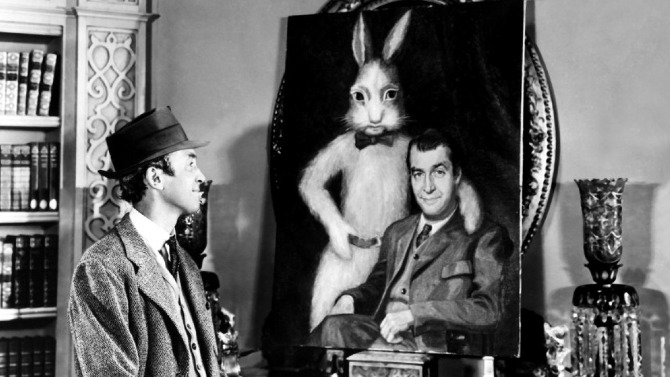
HarveySeptember 4, 2016If a stage play is to be successful, it needs to rely on the strength of two very important aspects – its actors and sharp dialogue. The one thing that I have come to notice when watching an adaptation of a play is that the dialogue that transitions over to the big screen is almost always beautifully written, unbelievably witty and surprisingly eloquent. There is perhaps no better example of this than the 1950 classic Harvey. Mary Chase adapts her own Pulitzer Prize winning play (with some help from Oscar Brodley), bringing with her Jimmy Stewart and Josephine Hull, two actors who had already tackled the material on the stage. Stewart plays Elwood P. Dowd, a kindly and charming gentleman who comes from a well-to-do family. He has a lovely demeanor, but is thought to drink too much (he does spend most of his days frequenting bars) . . . and also just happens to be friends with an invisible, six foot three and a half inch tall rabbit named Harvey.
-
Star Pick with Steve Coulter
 Cool Pick for Dog Days of SummerDog Day AfternoonAugust 30, 2016
Back in April of 2016, I sat down with actor Steve Coulter (twice). He was one of the special guests attending the Cornwall and Area Pop Expo (CAPE). The character actor, who has had a plethora of interesting roles over his career, is perhaps best remembered as the kind hearted, intellectual Reg Monroe (the mastermind behind the walled compound of Alexandria) on the ever popular series The Walking Dead. He has also had a recurring role as Amishman Elijah Bowman on the standout Cinemax series Banshee. On the film front, he has worked with horror maestro James Wan an impressive five times, including as Father Gordon in The Conjuring and its sequel, as well as playing Carl in Insidious: Chapter’s 2 and 3. He also portrayed Roger, a lawyer, in one of my favourites – Mr. Brooks. Mr. Coulter was gracious enough to be interviewed twice, once as part of a local Cogeco special, while on day two of CAPE, we chatted all things Banshee. Check out both meetings below to hear some great stories from all the things mentioned above, as well as his favourite film.


