 Films That Matter
Pit Stop
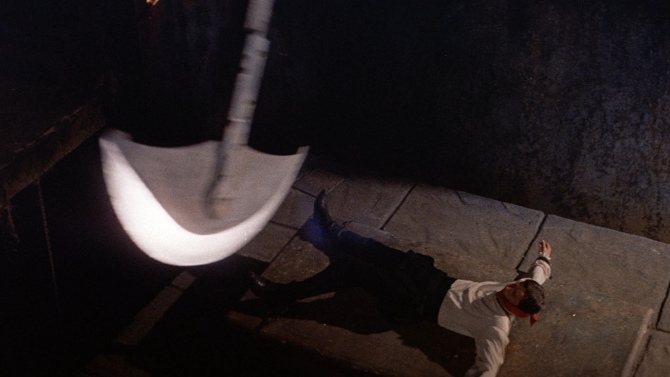
After Roger Corman’s major success with House of Usher (1960), he promptly turned to adapting another Edgar Allan Poe story to start a franchise of sorts, with The Pit and the Pendulum (1961) being an even bigger win... with it making over two million dollars on a modest budget of only three hundred thousand. Getting Vincent Price (House of Wax; Laura) back after House of Usher’s critical and commercial winnings, this time he plays Nicholas Medina, a tortured soul living in a tomb of a castle with his servants after his gorgeous wife Elizabeth (Barbara Steele – Black Sunday; The Horrible Dr. Hichcock) has seemingly died of a massive heart attack brought on by fright. Feeling as if he is truly cursed, he resides in the same place that his sadistic Spanish Inquisition father once tortured his victims, where his mother and uncle died, and now where his wife has met her untimely end. It has become so bad that even Nicholas’ sister Catherine (Luana Anders) has returned home to try and ease his sorrows.
-
Star Pick with John 'Moose' Wensink
 Paint Your Wagon; An Oddly Entertaining MusicalPaint Your WagonAugust 23, 2016
Back in September 2013, former heavyweight tough guy for the Boston Bruins, John ‘Moose’ Wensink, was roasted in Cornwall to raise money for the Children's Treatment Centre. Following the event, I interviewed the former NHLer. When asked what his favourite film of all-time was, he quickly proclaimed Paint Your Wagon. When asked why, he simply replied, "Why not?" This article, with a few changes added, is the same that was published back on December 17th, 2014. I recently golfed with Wensink at Upper Canada Golf Course in Morrisburg, Ontario (on July 22nd, 2016), and he was gracious enough to expand on the interview we did back in 2013. You can see the video interview down below, where the man takes us through his storied career and expands on his love of Paint Your Wagon.
-
Prison Break, McQueen Style
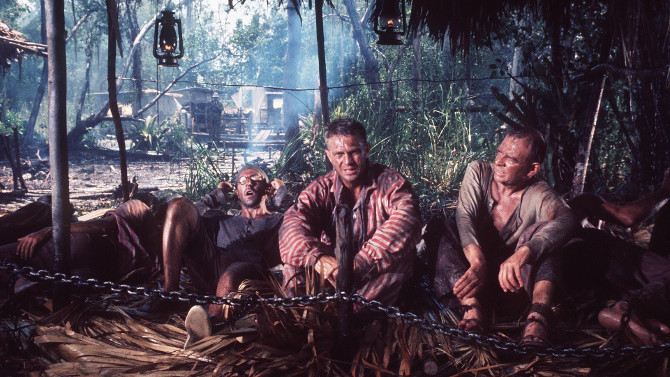
PapillonAugust 21, 2016There are certain actors that have the ‘cool’ factor. Not the easiest thing to define, there is just something about their larger than life personas that attract us to them. One such actor is Steve McQueen. It seems that each role he chose further expanded his reign as a cool cat, with films like The Great Escape and Bullitt helping fuse together his characters with the real person – creating an image of a man’s man whose tall lean frame drove muscle cars through San Francisco during the week while escaping from Nazi concentration camps on the weekend. Another motion picture that epitomizes his persona is the 1973 prison drama Papillon. Based on the autobiography by French convict Henri Charrière, director Franklin J. Schaffner (Patton/Planet of the Apes) takes us on an epic ride as Charrière, whose moniker is Papillon (McQueen), as he has a vivid tattoo of a butterfly that can be found on the middle of his chest, is placed on a ship departing from France.
-
Star Pick with BarBara Luna
 This Film ‘Rains’ SupremeSingin' in the RainAugust 10, 2016
Set in the late 1920s, Singin’ In the Rain captures the drastic and very abrupt change that occurred as the ‘talkie’ craze took off after the legendary film The Jazz Singer was released in 1927 – lampooning the transition with a melange of sharp satire, simple gags as well as show-stopping song and dance numbers (and some straight-forward audible dialogue, too). At CAPE Cornwall 2016, I had the pleasure of speaking with actress BarBara Luna, who has been working in the industry for sixty five years. Over the course of her intriguing career, she has worked with countless icons, including Spencer Tracy/Frank Sinatra (The Devil at 4 O’Clock), Peter Lorre (Five Weeks in a Balloon), Jimmy Stewart/Henry Fonda (Firecreek), to name but a few.
-
Star Pick with Louise Sorel
 Mama Knows BestI Remember MamaJuly 26, 2016
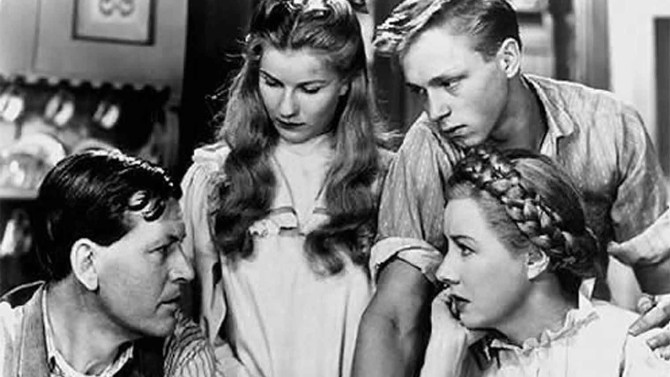
The saying ‘they don’t make films like that anymore' is often bandied about when it comes to classic movies. It is something that is difficult to quantify or describe as to why it is so, but when you see it, it seems self evident. One motion picture that has this unusual quality is the 1948 film I Remember Mama. I recently spoke to Louise Sorel at CAPE Cornwall. You may recognize the actress if you are a fan of soap operas;
-
Star Pick with Billy Smith
 Saving the Universe with Billy SmithStar Wars: Episode IV - A New HopeJuly 19, 2016
Clutch is a term that is often synonymous with big time athletes in sports. There are certain players that, when the match is on the line, elevate their game to another level. They have the innate ability to shift into another gear, making it feel like they are seeing the game much more clearly than the rest of the athletes. One such National Hockey League player is former New York Islanders’ goaltender Billy Smith. The winner of four straight Stanley Cups from 1980-1983,
-
Boulevard of Broken Dreams
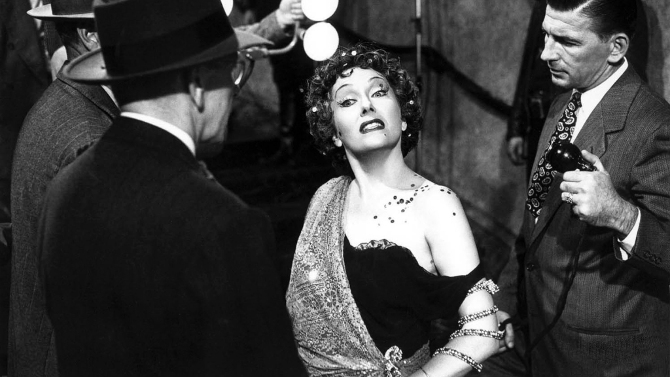
Sunset BoulevardJuly 17, 2016With the steamy heat of summer upon us, it is time to revisit one of my favourite genres – the dark, seductive, hard-boiled stories of film noir (from the 1940's and 50's). Billy Wilder, one of the great directors of the twentieth century, created three classics that fall within this genre: 1944's Double Indemnity (which I have already reviewed), 1951's Ace In the Hole and the 1950 iconic motion picture Sunset Blvd. – which will be reviewed here today.