 Films That Matter
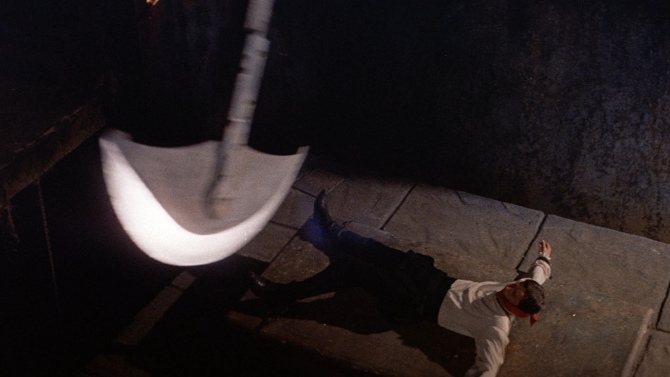
Pit Stop
After Roger Corman’s major success with House of Usher (1960), he promptly turned to adapting another Edgar Allan Poe story to start a franchise of sorts, with The Pit and the Pendulum (1961) being an even bigger win... with it making over two million dollars on a modest budget of only three hundred thousand. Getting Vincent Price (House of Wax; Laura) back after House of Usher’s critical and commercial winnings, this time he plays Nicholas Medina, a tortured soul living in a tomb of a castle with his servants after his gorgeous wife Elizabeth (Barbara Steele – Black Sunday; The Horrible Dr. Hichcock) has seemingly died of a massive heart attack brought on by fright. Feeling as if he is truly cursed, he resides in the same place that his sadistic Spanish Inquisition father once tortured his victims, where his mother and uncle died, and now where his wife has met her untimely end. It has become so bad that even Nicholas’ sister Catherine (Luana Anders) has returned home to try and ease his sorrows.
-
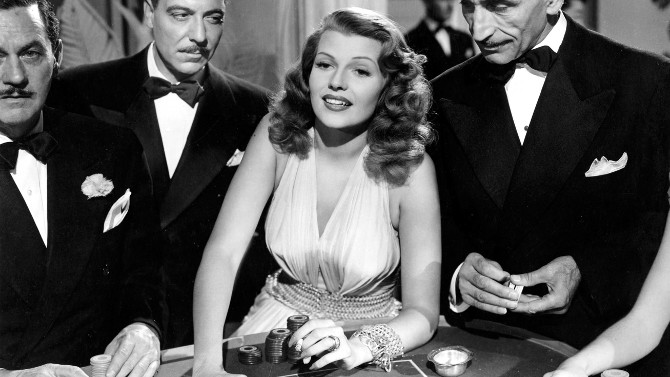
Luck be a Lady Tonight
GildaApril 10, 2016There is nothing like a memorable entrance/introduction to an onscreen character. The film that I am reviewing today has three. As the camera pans up at the very beginning of the movie, we are nearly hit by voice over narrator Johnny Farrell’s (Glenn Ford) trick dice. As he leaves the sketchy gambling room (after easily winning some cash with his fake cubes), he is held at gunpoint by a robber. In comes his saviour and soon to be boss, Ballin Mundson (George Macready), who uses his ‘best friend’, a walking stick that hides a dangerously long and sharp bayonet to save the nervous man. But it is the third and final entrance that blows the other two away. After Farrell begins to work for Mundson for some time, he learns, upon his bosses return from a trip, that he has gotten married. As the two enter the dame’s bedroom, her husband asks, "Gilda, are you decent?". Rita Hayworth’s title character, after a slight pause, pops up on the screen, and with a sensual flip of her perfect locks, flirtatiously responds "Me?". Dare I say, drama ensues.
-
Scare Up Some Laughs
 Hold That GhostAbbott and Costello Meet FrankensteinApril 8, 2016
There are many classic comedians that are still honoured and remembered fondly today. People like the Marx Brothers, the Three Stooges, Charlie Chaplin and Buster Keaton are highly regarded funny men, yet the comedy team of Bud Abbott and Lou Costello are, in my opinion, less quickly thought of than those mentioned above. Despite this, many of their films, which include a mixture of memorable physical comedy and witty dialogue, still hit the funny bone today. Two of my favourites mix comedy with the horror genre: 1941's Hold That Ghost and 1948's Bud Abbott and Lou Costello Meet Frankenstein.
-
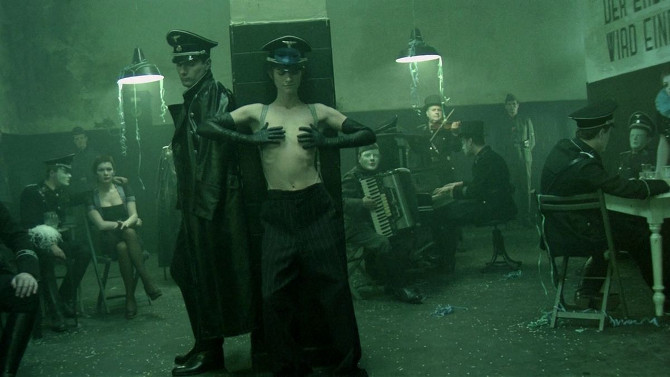
A Fateful Reunion
The Night PorterApril 5, 2016Controversial, edgy, tasteless and taboo are just a few words that have been used to describe the movie that I will be reviewing today. If there was ever a love it or loathe it film – this may be it. It has been chosen by the acclaimed company Criterion as being one of their ‘important classic and contemporary films’ and many film afficionados have lauded it, yet others have absolutely trashed it – with legend Roger Ebert proclaiming that it is "as nasty as it is lubricious, a despicable attempt to titillate us by exploiting memories of persecution and suffering". I will leave it to you to decide.
-

The Kid is Hot Tonight
In Old ArizonaMarch 29, 2016Sometimes, a film is able to transcend the era it was made in, truly making it feel as relevant and modern as when it was first released. Yet, others simply have not aged as well. This can sometimes create a rather difficult viewing experience – and that is somewhat the case with the 1928 western In Old Arizona. This western is one of the most important and influential films of the time –
-
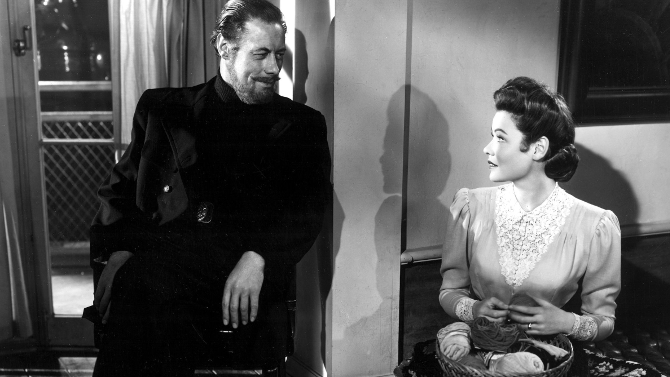
A Haunting Love Affair
The Ghost and Mrs. MuirMarch 22, 2016Every once and a while, a writer devises a ghost story that is not mere horror or thriller, but expands the eerie vibe to a more intimate otherworldly friendship or romance. Two of my favourites are the oddball buddy comedy Blackbeard’s Ghost (released by Disney in 1968) as well as the 1990 romantic dramedy simply titled Ghost. I now have a third excellent film to add to this rather abstract list – the 1947 motion picture The Ghost and Mrs. Muir.
-

A Gringo Walks Into a Cantina…
Ride the Pink HorseMarch 11, 2016His name, Lucky Gagin . . . or Robert Montgomery for those of you who are looking for the actor portraying this anti-hero. Montgomery, the iconic star, also tried his hand at directing (for the second time), with this rather unorthodox film-noir, Ride the Pink Horse. Our lead walks off a bus and into the city of San Pablo, a Mexican border town that is getting ready to host an annual fiesta.
