 Films That Matter
Pit Stop
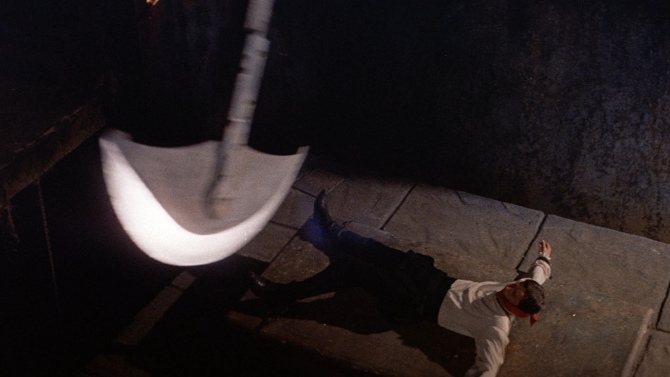
After Roger Corman’s major success with House of Usher (1960), he promptly turned to adapting another Edgar Allan Poe story to start a franchise of sorts, with The Pit and the Pendulum (1961) being an even bigger win... with it making over two million dollars on a modest budget of only three hundred thousand. Getting Vincent Price (House of Wax; Laura) back after House of Usher’s critical and commercial winnings, this time he plays Nicholas Medina, a tortured soul living in a tomb of a castle with his servants after his gorgeous wife Elizabeth (Barbara Steele – Black Sunday; The Horrible Dr. Hichcock) has seemingly died of a massive heart attack brought on by fright. Feeling as if he is truly cursed, he resides in the same place that his sadistic Spanish Inquisition father once tortured his victims, where his mother and uncle died, and now where his wife has met her untimely end. It has become so bad that even Nicholas’ sister Catherine (Luana Anders) has returned home to try and ease his sorrows.
-
Star Pick with Chris 'Knuckles' Nilan
 Patton Four Star MoviePattonDecember 17, 2014
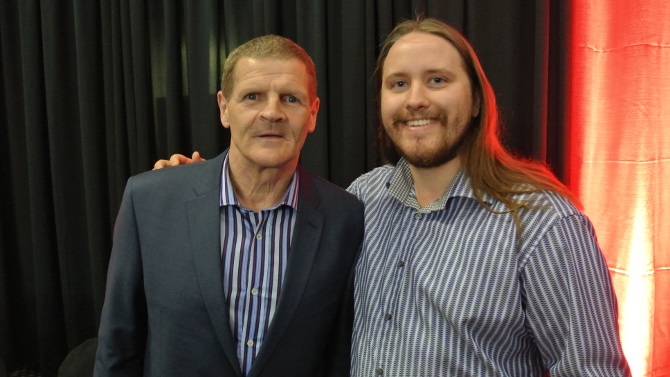
Two weekends ago, Agape held their annual charity boxing event at Nav Can. This year, their invited celebrity was none other than former NHL heavyweight Chris ‘Knuckles’ Nilan, who supported the event in order to raise money to help battle hunger. The Boston Massachusetts native, who played for such teams as the New York Rangers, Boston Bruins and for most of his career, the Montreal Canadiens (winning his only Stanley Cup with the team in 1986), is fondly remembered for holding numerous records that landed him in the sin-bin and being one of only nine players to ever reach more than 3000 penalty minutes.
-
Star Pick with Sharon Osbourne
 Lawrence of Arabia an Epic MasterpieceLawrence of ArabiaDecember 17, 2014
Last week, Sharon Osbourne, the media personality known for her reality television show The Osbournes (along with rock star husband Ozzy and their children), as well as being a judge on America’s Got Talent and more recently, one of the co-hosts of the daytime series The Talk, was gracious enough to sit down with me for a few minutes to talk film. It did not take Mrs. Osbourne long to single out her favourite – the 1962 epic Lawrence of Arabia. She was captivated by the superb scenery and the brilliant cinematography of legendary director David Lean (The Bridge on the River Kwai, Doctor Zhivago), which made this movie and its imagery unforgettable.
-
Star Pick with Jesse Winchester
 Good Will for This Classic 90’s MovieGood Will HuntingDecember 17, 2014
The National Hockey League season is now underway and for those who are fans of the sport, this is an exciting time of year. I was lucky enough to golf with Jesse Winchester this year, and though it was a somewhat rainy afternoon, it was still an excellent day. The Long Sault native is making his way back to our neck of the woods, as his team, the Colorado Avalanche, are playing in Ottawa on Thursday and in Montreal on Saturday – so I thought it would be a good time to visit this NHLer’s favourite movie – Good Will Hunting.
-
Star Pick with Joel O'Keeffe
 Die Hard with AirbourneDie HardDecember 17, 2014
I have been lucky enough to meet a lot of interesting and famous people in my life. One such person is rock star Joel O’Keeffe, the lead guitarist and singer of the Australian hard rock and roll band Airbourne, whose song Live It Up went number one in Canada this year (the first of their career in any country). I have been able to spend quite some time with the guys from Airbourne, and as you can probably guess, it did not take long for the conversation to turn to movies. Joel’s favourite film is the legendary action flick Die Hard, which he calls "the greatest film ever!!" He also added that, "Die Hard literally set the benchmark and wrote the book for the ‘One Man vs. heaps of Terrorists’ blockbuster action flick".
-
Star Pick with Billy Gibbons
 Casablanca on TopCasablancaDecember 17, 2014
We are now in the middle of the awards season and are closing in on the holy grail of film festivities: the Academy Awards, or as we all like to call him – Oscar. This month, I will be reviewing four motion pictures that have won at least one of the major prizes of either best director, actor, actress or picture.
-
Star Pick with Jacques Demers
 A Race for GoldChariots of FireOctober 6, 2014
I must say that when I asked Senator Jacques Demers the question of what his favourite movie was at the Children’s Treatment Center Roast a few weeks ago – he was caught off-guard. He initially named the previously reviewed Forrest Gump, yet after he roasted local MP Guy Lauzon, he pulled me aside in order to mention that the Hanks’ offering was not the sole movie at the top of his list – the 1981 Academy Award Best Picture Chariots of Fire was equally as important to him.