 Films That Matter
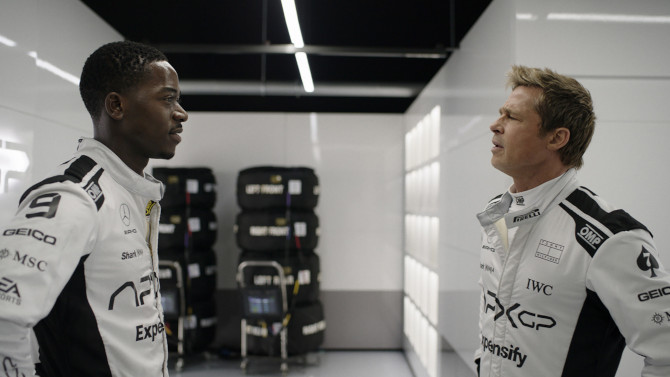
A Pitt Stop
After director John Kosinski got the need for speed while making the big smash hit sequel Top Gun: Maverick back in 2022, he clearly wanted to stay in the fast track, deciding to co-write and direct what has become one of the 2026 Academy Award Best Picture nominees – F1: The Movie (2025). With racer Lewis Hamilton on board as a producer and the film making team getting permission from all of the actual F1 racing teams, they shot at real Grand Prix weekends throughout the 2023 and 2024 seasons, with a faux garage set up between the Mercedes and Ferrari pits... making things look as accurate and impressive as possible. Following longtime driver Sonny Hayes (Brad Pitt – who did most of his own racing), he has become a jack of all trades of sorts – driving everything from F1 and Daytona, to taxi in New York, he is basically a meandering racer-for-hire.
-

Something Wick This Way Comes
John Wick: Chapter 2February 21, 2017A perfect case of ‘just when I thought I was out, they pull me back in’, John Wick: Chapter 2 starts off soon after the original feature. Starting with a video of Buster Keaton projected onto a New York City wall, Wick (Keanu Reeves) is like one of those silent film stars of the 1920s – though much more violent. A man of few words, he bumps, crashes and bangs his way through foes, a wandering ‘tramp’ with no true home, albeit, wealthier, better dressed and much more connected. Keaton, nicknamed "The Great Stone Face" has the same stoic demeanor as our protagonist – who, for the most part, plays things close to the vest.
-

Arrival Comes Full Circle
ArrivalFebruary 19, 2017We like to think of things in our lives as fitting into a nice square box. Everything has an order, with the structured days of the week to our routines fitting into this comforting perspective. We do not want to think of life as being random, chaotic and lacking a straightforward linear form – as it reminds us that things are not truly in our control. It is this linear way of thinking that is questioned in the 2016 cerebral science fiction film Arrival. Eric Heisserer adapts the text "The Story of Your Life" (written by Ted Chiang), placing it in the hands of talented French Canadian director Denis Villeneuve. Having a twofold narrative, the main portion follows the landing of twelve spacecrafts in random places around the world. With people beginning to panic and riot (as no indication has been made, either peaceful or otherwise), the government attempts to make some sense out of the unorthodox and exceptional arrival. Colonel Weber (Forest Whitaker) reaches out to linguist Dr. Louise Banks (Amy Adams), a woman with immense knowledge of numerous dialects and written languages (and military clearance to boot). She leads a team along with physicist Ian Donnelly (Jeremy Renner), the Colonel, and several other military men who will record the data after they enter the hull of the dark, kidney-shaped foreign craft located in Montana.
-

Where Black Stars Shine
Hidden FiguresFebruary 10, 2017The title of Hidden Figures, one of 2017's Academy Award Best Picture nominees, has a double meaning. Speaking to the mathematics that is at the heart of the space travel film, it more subtly references the story of its three African American female leads, who, despite playing a big part in Space Race history, have been lost to time. . . until now. Depicting the combative duality of the Cold War, writer/director Theodore Melfi (who adapts Margot Lee Shetterly’s book of the same name, along with Allison Schroeder) captures the essence of this complicated time. On the surface, it is America versus Soviet Union – funnelled through the propaganda-filled battle that centres around who will win the Space Race; though, more specifically, it portrays the civil rights battle, a world where, in 1961 Virginia, everything is still segregated. Written with deft precision, dialogue like "Civil Rights ain’t always civil", which is uttered by Levi Jackson (Aldis Hodge), succinctly represents this era; while a scene that appears towards the end, where mathematician Katherine G. Goble (Taraji P. Henson) hurriedly delivers some updated calculations for John Glenn’s (Glen Powell) all important mission – only to have the door slammed in her face after all of the white personnel have been ushered into the room, highlights the atrocities and unfairness of the era, while also showing how far we have come and how much farther we still have to go.
-

La La Land – Where the Music Speaks
La La LandFebruary 6, 2017Upon first watching the visually arresting musical drama La La Land, I perhaps unusually thought about the excessive amount of traffic on the road. I surmised, macabrely, that the main characters of the film, who spend several scenes dancing on the streets of Los Angeles, would have likely been killed early on by a speeding car, making the whole motion picture a sort of life flashing before your dying eyes moment. My bizarre sense of humour aside, Damien Chazelle’s follow up to his 2014 drumming drama Whiplash is a mesmerizing story about following your dreams, reaching for the stars and fighting against the major hurtles along the way. Though, just because we chase said dreams, it does not mean that they are always attainable. At one point, our male lead, Sebastian (Ryan Gosling), frustratingly complains of the Hollywood mindset: "they worship everything and value nothing".
-
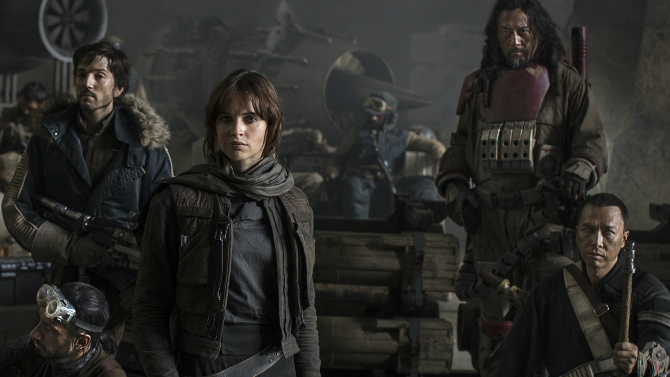
Going Rogue
Rogue One: A Star Wars StoryDecember 20, 2016The first stand-alone film in the Star Wars universe, Rogue One bridges the gap between episodes 3 (2005's Revenge of the Sith) and 4 (the original 1977 motion picture); it is also a movie that lives in the grey zone more than any other in the operatic space saga – depicting the complexity of the actions executed by the Rebel forces that are our protagonists. What we see is a complicated universe filled with spies, traitors and extremists – a place where no decision is an easy one. Our lead character, Jyn Erso (Felicity Jones), is a perfect example of this, for when she was young, her father, Galen (Mads Mikkelsen), a weapons developer, was forcibly taken by Imperial baddie Orson Krennic (Ben Mendelsohn) to finish work on the Death Star (the planet killer from A New Hope). This leaves the impressionable girl in the hands of a radical, ultra dangerous Rebel fighter by the name of Saw Gerrera (Forest Whitaker), who deserts her at the age of sixteen.
-
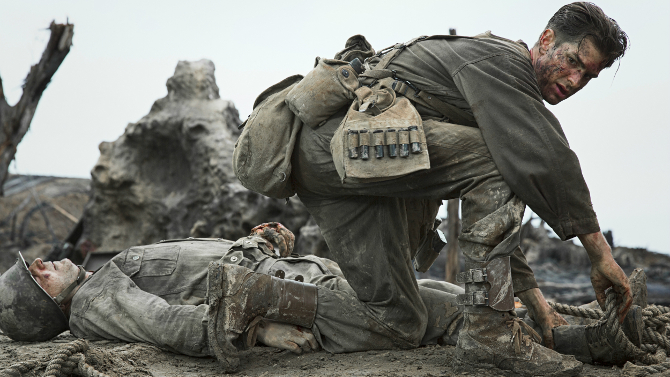
War and Peace, Gibson Style
Hacksaw RidgeDecember 16, 2016Juxtaposing the horrors of war around a message of peace, Mel Gibson’s 2016 offering, Hacksaw Ridge, is a rivetting piece of film making, capturing a touching love story, a complex family dynamic and harrowing battle sequences, giving us a rich, multi-faceted tapestry. Providing us with an effective window into the upbringing of our main character, Desmond Doss (Andrew Garfield), Gibson is easily able to make us bond with our lead. Each aspect of the first third of the movie, where we see this boy grow into a young adult, is perfectly chosen, as it renders us with a vision of exactly who he is as a human being. Son to a kind mother, Bertha (Rachel Griffiths), and a complicated, abusive father, Tom (Hugo Weaving), who is struggling with demons from his time spent in the military during World War I, he also has a brother nicknamed Hal (Nathaniel Buzolic). Nearly killing his brother after a tussle at a young age, Desmond becomes focussed on the Sixth Commandment: thou shalt not kill.