 Films That Matter
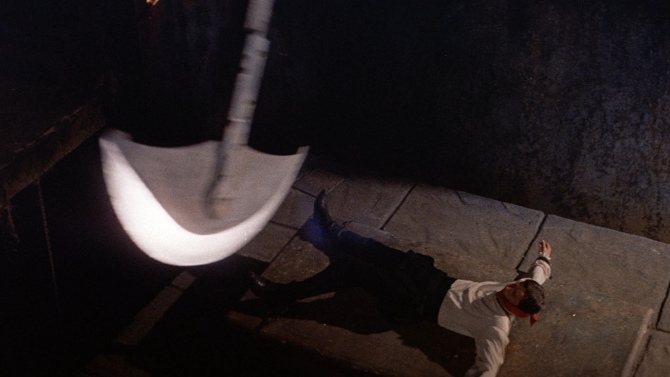
Pit Stop
After Roger Corman’s major success with House of Usher (1960), he promptly turned to adapting another Edgar Allan Poe story to start a franchise of sorts, with The Pit and the Pendulum (1961) being an even bigger win... with it making over two million dollars on a modest budget of only three hundred thousand. Getting Vincent Price (House of Wax; Laura) back after House of Usher’s critical and commercial winnings, this time he plays Nicholas Medina, a tortured soul living in a tomb of a castle with his servants after his gorgeous wife Elizabeth (Barbara Steele – Black Sunday; The Horrible Dr. Hichcock) has seemingly died of a massive heart attack brought on by fright. Feeling as if he is truly cursed, he resides in the same place that his sadistic Spanish Inquisition father once tortured his victims, where his mother and uncle died, and now where his wife has met her untimely end. It has become so bad that even Nicholas’ sister Catherine (Luana Anders) has returned home to try and ease his sorrows.
-
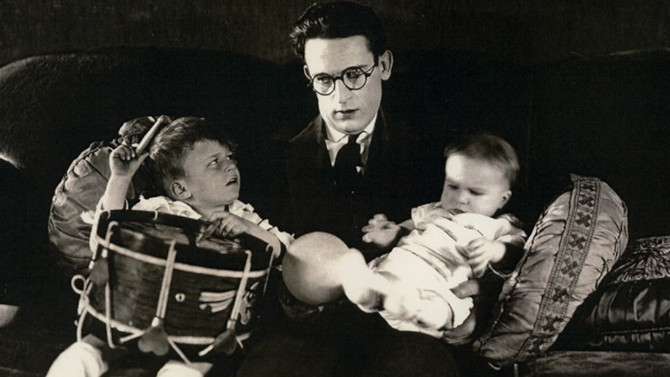
Hughes’ Clues
I DoMarch 9, 2021I have to wonder whether John Hughes ever saw the Harold Lloyd short film I Do (1921), directed by Hal Roach. . . as its story shares some striking similarities to his festive holiday classic script for Home Alone (1990), directed by Chris Columbus. A twenty-two minute ditty on a newly married couple, The Boy (Lloyd) joins in union with The Girl (Mildred Davis – who would marry Lloyd just two short years later) – a nice touch finds some early animation depicting the ceremony. Flashing forward to a year later, a gag makes us first think they may have already had their own child. . . but it is not so. . . and maybe that’s a good thing. Asked to babysit the two children of the Brother-in-Law (William Gillespie), the narrative definitely doesn’t hold anything back – as they are named The Disturbance (Jack Morgan) and The Annoyance (Jack Edwards).
-
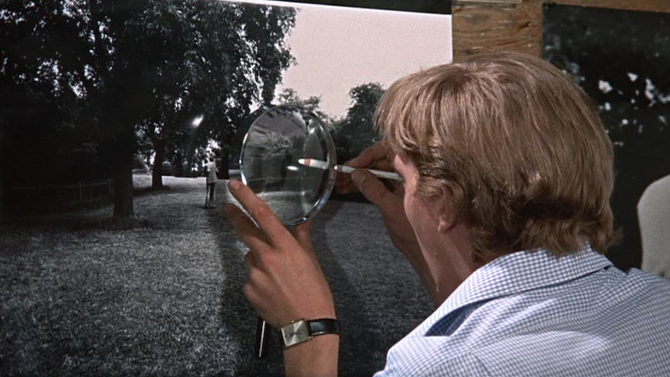
Just Out of Focus
Blow-UpFebruary 27, 2021One of the most iconic films showing off 1960s London (specifically 1966) is intriguingly written and shot by an Italian, Michelangelo Antonioni’s Blowup (which is sometimes hyphenated or has a space between the two words), an abstract vision of this most unique and swinging time. Seen through the eyes (or should I say camera – a sort of heightened reality) of famed photographer Thomas (David Hemmings), it is immediately noticeable that he is a walking juxtaposition. Both energetic and apathetic, he has more ups and downs than a roller coaster. Lacking passion or a proper plan, the story, like his unknown future aspirations, doesn’t follow a traditional plot pattern.
-

River Rafting
River of No ReturnFebruary 16, 2021Long before the wilderness of Alberta awed and amazed in Alejandro G. Iñárritu’s 2015 frontiersman epic The Revenant, it was widely featured in an impressive Technicolor CinemaScope picture, Otto Preminger’s 1954 western River of No Return. Shot in the beauty of Banff and Jasper National Parks (though some of the river scenes are shot at Salmon River in Idaho – where the actual story takes place), the scrumptious background is matched by the glorious foreground. . . which held two Hollywood greats – the chiseled features of Robert Mitchum and a woman whose looks need no descriptors, Marilyn Monroe (a rather intriguing historical note finds the actress causing a pile-up on the main street of Jasper while walking down the street in her tight-fitting jeans that she wears throughout most of the movie).
-
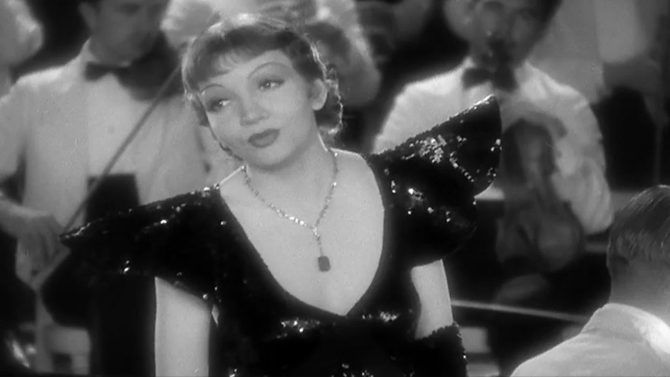
Carrying A Torch
Torch SingerFebruary 7, 2021A pre-Code movie that by today’s standards might not seem all that controversial, but would not have made it to theatres just one year later (when the Production Code started to be enforced), 1933's Torch Singer, directed by Alexander Hall and George Somnes, provides an intriguing snapshot of the time. Centred on a strong female performance (something less rare than you might expect for the 1930s) by Claudette Colbert, she plays Sally Trent, a young woman who quickly slept with her first love. . . only to find out she’s pregnant. Pause!
-

W.O.W.!!!
The War of the WorldsJanuary 24, 2021Talk about a buildup. . . starting with the First World War, then came the Second World War, it all leading to. . . The War of the Worlds!!! A gargantuan and ballsy way to introduce your film, these black and white reels from the first half of the twentieth century give way to garish colours of the Atomic Age in Byron Haskin’s modernized 1953 take on the iconic H.G. Wells novel. Controlled by ambitious producer George Pal (who both produced and directed The Time Machine), he obtained the material after it sat on legendary director Cecil B. DeMille’s desk for some three decades (it was always a dream project for him). Bringing in a talented team of creative individuals, it was longtime special effects man turned director Byron Haskin who was his choice.
-
Rock `n Roll Fantasy
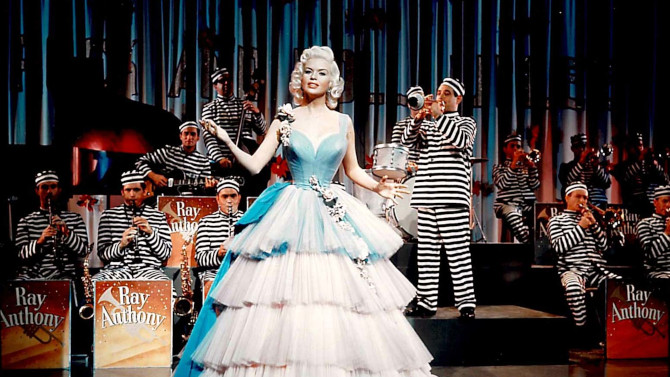
The Girl Can't Help ItDecember 19, 2020As light and frivolous as a wispy summer cloud meandering across a baby blue sky, 1956's The Girl Can’t Help It, written and directed by Frank Tashlin, though perhaps at first glance not as influential (or known) as its very similar cousin from the previous year, The Seven Year Itch, is an entertaining musical comedy that had a huge impact on pop culture. . . though intriguingly not on the movie industry (but more on that later). Flipping the script slightly from the Billy Wilder classic, Tom Ewell plays a similarly twitchy man, an alcoholic press agent, Tom Miller, who ironically thinks himself an adonis despite his rather frail, nervous demeanor around women. Instead of being slightly bored in a staid marriage, he has instead lost his chance at telling his former singing sensation client Julie London (as herself) that he was falling for her – she has now moved on to bigger and better things.