 Films That Matter
Pit Stop
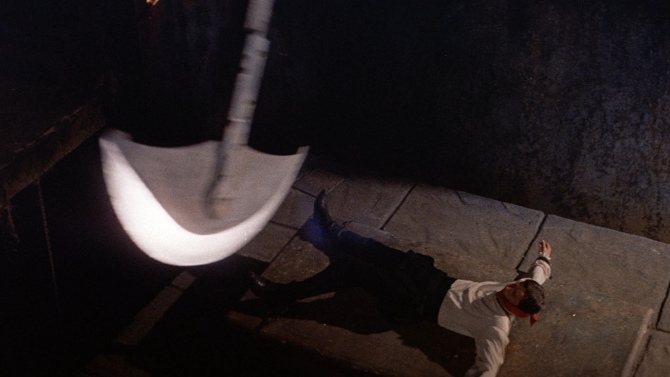
After Roger Corman’s major success with House of Usher (1960), he promptly turned to adapting another Edgar Allan Poe story to start a franchise of sorts, with The Pit and the Pendulum (1961) being an even bigger win... with it making over two million dollars on a modest budget of only three hundred thousand. Getting Vincent Price (House of Wax; Laura) back after House of Usher’s critical and commercial winnings, this time he plays Nicholas Medina, a tortured soul living in a tomb of a castle with his servants after his gorgeous wife Elizabeth (Barbara Steele – Black Sunday; The Horrible Dr. Hichcock) has seemingly died of a massive heart attack brought on by fright. Feeling as if he is truly cursed, he resides in the same place that his sadistic Spanish Inquisition father once tortured his victims, where his mother and uncle died, and now where his wife has met her untimely end. It has become so bad that even Nicholas’ sister Catherine (Luana Anders) has returned home to try and ease his sorrows.
-
Star Pick with William Ragsdale
 Fright TonightThe ChangelingOctober 31, 2023
I was fortunate to be able to interview actor William Ragsdale on April 24th 2022, at the Cornwall and Area Pop Event (or CAPE). A most entertaining event each and every year, one of the highlights was a reunion of Ragsdale and Amanda Bearse – two of the stars of Tom Holland’s horror cult classic Fright Night (you can find their recollections of the film, as well as Ms. Bearse’s Star Pick interview here on Filmizon.com). It is also worth noting that Ragsdale returned for Fright Night’s sequel, and has continued working ever since... recently having a memorable three year stint on the excellent series Justified... while speaking of horror, he had a cool cameo in 2023's Renfield – back in the vampire realm once more. When our conversation turned to his favourite film, it did not take him long to highlight a horror classic – 1980's The Changeling, starring George C. Scott. This is what he had to say: “I love that movie [The Changeling]. When it came out I thought it was brilliant. It had strong performances from George C. Scott and Melvyn Douglas. For me, the shock stuff is not so great, I really love the ambience and how things are created... it is almost like how Guillermo del Toro builds his atmosphere. I really like feeling like this is a place I’m going into and hanging out. And, of course, that movie was all about that. If the setting is correct, I enjoy it – and The Changeling just had it.” It is also worth noting that he gave a shout-out to The Exorcist earlier in the interview as well.
-

Watch The Skies
The Thing from Another WorldOctober 29, 2023Before there was John Carpenter’s The Thing (1982), there was The Thing from Another World (1951). If you know John Carpenter, it is not overly surprising that he would remake this film, for when I interviewed him back in 2017, he could not stop speaking of his love for film maker Howard Hawks (citing him as a major influence on his career, he was enamoured with his genre jumping films – be it western, drama or horror)... and Hawks’ fingerprints are all over the 1951 version. It is also worth noting that Carpenter, just five years before making The Thing, had Hawks’ original make a screen appearance in his legendary Halloween. Still debated as to whether it was Hawks who directed the film or the co-credited Christian Nyby, not even the cast has been able to agree. Some called Nyby the director but Hawks the boss, while other recollections remembered Hawks doing most of the work. Without ever having a true answer, it seems most likely that Nyby directed under the tutelage of Hawks, with the elder statesman taking charge from time to time (hence why the film has such a feeling of the veteran film maker’s work). There is no denying that he co-wrote and co-produced the film.
-

The Park, The Rain, and Other Murderous Things
She-Wolf of LondonOctober 10, 2023Taking a more melodramatic angle of the horror genre, towards the end of Universal’s golden age of scary movies comes 1946's She-Wolf of London, directed by Jean Yarbrough – a change of pace from the Lon Chaney Jr. led Universal features (he had already played the Wolf Man four times to this point, and would soon do so one last time in Abbott and Costello Meet Frankenstein). A period piece set in London, horrific murders continue to take place in a local park near the wealthy estate of the Allenby’s. Long rumoured to be cursed, the last vestige of the line is Phyllis Allenby (June Lockhart), a young, nervous woman who, instead of cheerfully planning her wedding to barrister Barry Lanfield (Don Porter), frets about the growing number of deaths in the vicinity – wondering if these acts might have been unknowingly done by her very own hand.
-
Wax Works
 House of WaxHouse of WaxOctober 3, 2023
A bonafide 3D early classic and a less than lauded remake, House of Wax (1953 and 2005 respectfully), are very different films. The former starring legendary actor Vincent Price and directed by André De Toth (Crime Wave), is a vividly coloured, horror tinged murder mystery, while the latter film, directed by Jaume Collet-Serra, is a moodily lit modern era slasher flick that is slowly being reappraised. One of the most successful 3D ventures of the 1950s era, De Toth frames Price’s wax artist, Professor Henry Jarrod, as a kindly and loving creative soul who is sadly betrayed by his business partner, Matthew Burke (Roy Roberts), who is a money hungry sociopath looking to invest elsewhere. Burning the wax museum down with its creator inside the building for the insurance money, the act brings bitter anger and utter madness to the once genteel artist, who somehow escapes with everyone believing he has perished in the fire.
-
Star Pick with Amanda Bearse
 Marcy’s PlaygroundTo Kill a MockingbirdJune 18, 2023
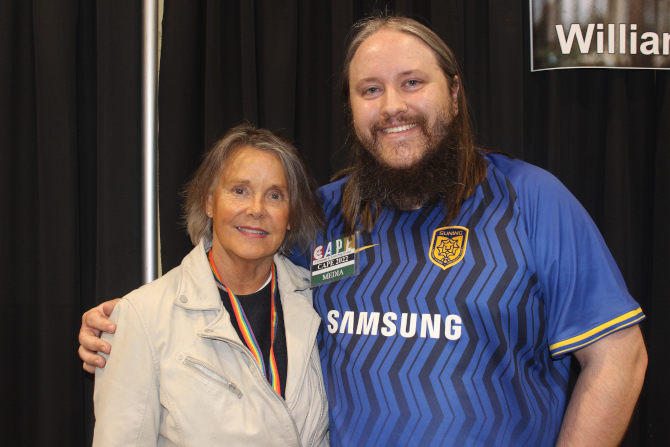
It was an absolute pleasure to meet and interview Amanda Bearse at CAPE 2022 (Cornwall & Area Pop Event). A multi-talented actor and director, she is perhaps best remembered as troublesome neighbour Marcy in the long running television sitcom Married... with Children (she appeared in an impressive 259 episodes, while she also sat in the directorial chair 31times). Yet, two years earlier, she appeared in what must have seemed at the time to be a horror quickie that would come and go... except the annals of cinema history were not done with Fright Night – it becoming a true cult classic of the 1980s that is still growing its viewing audience today. After wrapping Married, she decided to step behind the camera more often than not, directing numerous television series, including The Jamie Foxx Show, Dharma & Greg, Sabrina the Teenage Witch, Reba, Mad TV, to name but a few. For the first time in awhile, she is back in front of the camera with last year’s Bros and the upcoming comedy Tapawingo.
-
Star Pick with Joe Gatto
 No Ordinary ‘Joe’kerYoung FrankensteinMarch 12, 2023
I was fortunate enough to get a quick interview with Joe Gatto after his first ever comedy show in Ottawa on March 3rd, 2023. For those of you who have somehow missed him over the years, Gatto has brought joy and hilarity to the world with buddies Sal, Q, and Murr on the comedy series Impractical Jokers. After nearly a decade on television (creating worldwide catchphrases like: “Scoopski potahtos”, “Larry!”, “Up your ass and to the left”, “Who vants to paint!”, as well as so many others), Joe parted ways with the Jokers after nine seasons to focus more on family. Despite this, you’ve had ample chances to stumble upon him – sometimes with his buds as the Jokers go viral on Youtube, or by way of his very active social media accounts... and, of course, on his comedy tours. His first time in Canada, he regaled the audience with a fantastic combination of outright jokes, venue improv, past stories, and his own unique brand of physical comedy. After nearly a two hour show (which included his friend and opener Jiggy – who has also made some appearances on Impractical Jokers), the audience left with a number of jokes and stories that could make anyone laugh, as well as several local gags that only those attending would get (who knew Canadian royalty was sitting in the theatre box).