 Films That Matter
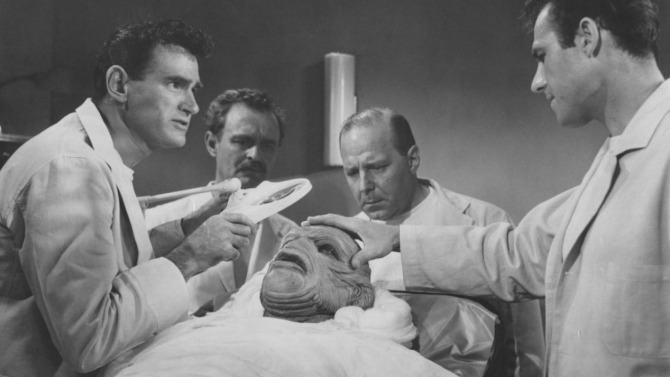
What Could Have Been: The Creature Walks Among Us
The third and final movie in The Creature from the Black Lagoon franchise, The Creature Walks Among Us (1956) was released just a year after the sequel and two after the original – clearly aiming to capitalize on the popularity of their horror creation... but sadly, it is better known as the last classic monster movie filmed by Universal. Directed by longtime assistant director John Sherwood (for the first time in the head chair thanks to some good words from Jack Arnold who directed the previous two), the story this time straddles the line between the original feature and a nature versus nurture premise that makes for a very different monster movie.
-

Birthday Blowout
Happy Birthday to MeAugust 6, 2019Ah, the birthday – a time for family, friends, presents and cake. . . but what if no one was to show up to that party? Could the effects of such a frightful occurrence have repercussions on a young child’s psyche? The genesis event of the 1981 Canadian slasher film Happy Birthday to Me finds veteran director J. Lee Thompson (1962's Cape Fear) transporting the audience into a violent murder mystery with a twist. Straddling the line of a slasher film and an Italian giallo, the killer is no mindless harbinger of undefeatable evil seen in features like Halloween and Friday the 13th, rather a sometimes straight-razor-wielding killer dressed all in black except for their white running shoes – I know what you are probably thinking, what horrible fashion sense. Furthermore, those being killed recognize their murderer, adding another layer to the mystery.
-
Body of Work
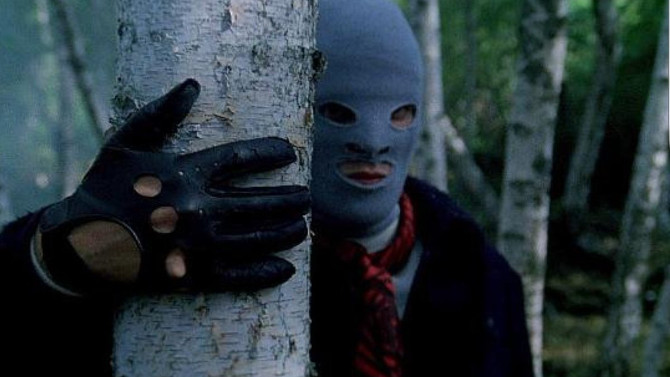
TorsoJune 24, 2019The ‘slasher’ sub-genre of horror is often said to have started with two films, 1974's Black Christmas and 1978's Halloween (while others might also lump 1974's The Texas Chainsaw Massacre in with that grouping), and that very much may be true, but some of its roots most definitely grew out of the giallo films of the late sixties and early seventies, case in point, Sergio Martino’s 1973 horror mystery thriller Torso – featuring all of the trimmings (pardon the pun) that would soon litter each and every slasher flick to come. Now, what should one expect to see in a movie like Torso. . . sex-crazed teens (who tend to investigate strange noises instead of finding safety, or wander off alone in unpopulated areas), suspicious looking peeping Tom’s (likely a red herring or two), an unknown psychopathic killer who uses some sort of bladed weapon (the suspense is killing me – as the murderer is masked. . . and not only uses a knife, but an ascot to strangle those unlucky individuals – I doubt it’s Fred from Scooby-Doo) – all these tropes would soon be found in your prototypical slasher film.
-
Overlord Overload
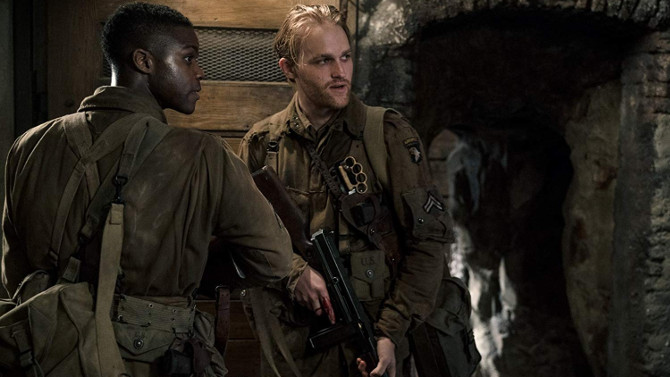
OverlordMarch 30, 2019A ‘B’ movie with loftier aspirations, 2018's Overlord, written by Billy Ray, directed by Julius Avery, and produced by J.J. Abrams’ Bad Robot Productions, is one of those rare movies that flips the script halfway through. . . but more on that later. On the eve of the D-Day invasion (during World War 2), a paratrooper squad has been given the gargantuan task of parachuting into a small town in France. . . their mission: to destroy a radio tower attached to an historic church – thus allowing the Allies to gain an upper hand during the paramount, multi-country attack the next day.
-

Missed the Bloody Cut: 2018 (Part 2)
October 30, 2018This second Missed the Bloody Cuts feature of 2018 (which follows the article posted on September 23rd) will also be the closing chapter of this year’s run of horror movies leading up to Halloween. And it has been nothing but a violently good run – spooky comedies from the Golden Age of Hollywood, cult classics, B horror flicks, British takes on the genre and everything in between. . . and this second set of reviews (which falls just below the 7.0 rating) resuscitates two lesser known 1970's motion pictures back from the grave. 1972's Season of the Witch (originally released as Hungry Wives and then re-released as Jack’s Wife) is the third film from zombie mastermind George A. Romero, a witch-tinged drama with horror themes. Following housewife Joan Mitchell (Jan White), the woman is haunted by her subconscious. . . living in a sedate marriage with a controlling husband who is oft on the road, Jack (Bill Thunhurst), the troubles of her bland life come out in her peculiar, disorienting dreams.
-
Gold, Frankenstein and Mirth (Don’t Forget the Wolf Man)
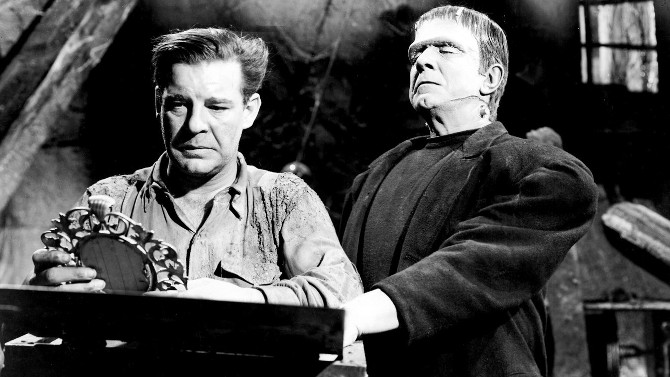
Frankenstein Meets the Wolf ManOctober 26, 2018The first of the Universal monster movie crossovers (which is celebrating its 75th anniversary this 2018), 1943's Frankenstein Meets the Wolf Man comes as the fourth sequel in the bolt-necked monster franchise, and a direct sequel to the tortured Lawrence Talbot feature, a man who was bitten by a werewolf and is now himself inflicted. Written by The Wolf Man scribe Curt Siodmak (and directed by Roy William Neill – a frequent 1940's Sherlock Holmes director), the screenwriter continues his tale of the tormented Talbot (Lon Chaney Jr. reprising his role) – cursed with the pentagram, the mark means that he is forever a pursued man (symbolic of the Star of David during World War 2, Siodmak, a German Jewish man, wrote the Wolf Man as a conduit for the horrid tale of his peoples’ torture, pain and death), a man who has supposedly been dead for four years.
-

Running Scared
2AM: The Smiling ManOctober 23, 2018Have you ever been walking late at night, and, as you travel your route, you hear someone following. . . the sound of their footsteps, slowly gaining, the ‘thud thud thud’ of their slightly quicker pace penetrating your deepest fears – your heart starting to palpitate as you pray that this is just mere happenstance and not some sort of psychotic stalker. This is the premise of the 2013 horror short: 2AM: The Smiling Man. Directed by Michael Evans (and based upon a Creepypasta – something I was unaware of until writing this article. . . it is a horror legend or image that has been copy and pasted around the Internet), the audience is placed in the shoes of a late night Roamer (Sean Simon), a twenty-something ‘anyman’ who is making his way home at 2 A.M. one night.