 Films That Matter
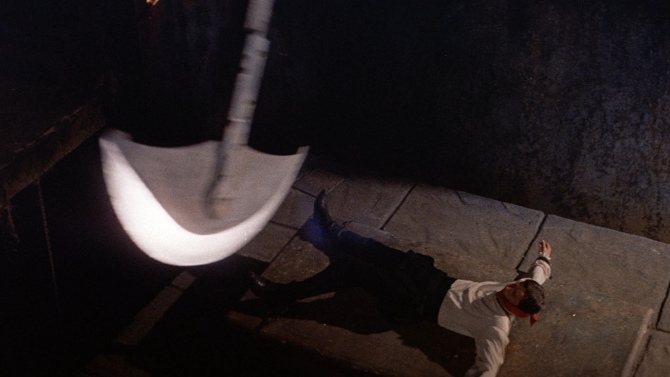
Pit Stop
After Roger Corman’s major success with House of Usher (1960), he promptly turned to adapting another Edgar Allan Poe story to start a franchise of sorts, with The Pit and the Pendulum (1961) being an even bigger win... with it making over two million dollars on a modest budget of only three hundred thousand. Getting Vincent Price (House of Wax; Laura) back after House of Usher’s critical and commercial winnings, this time he plays Nicholas Medina, a tortured soul living in a tomb of a castle with his servants after his gorgeous wife Elizabeth (Barbara Steele – Black Sunday; The Horrible Dr. Hichcock) has seemingly died of a massive heart attack brought on by fright. Feeling as if he is truly cursed, he resides in the same place that his sadistic Spanish Inquisition father once tortured his victims, where his mother and uncle died, and now where his wife has met her untimely end. It has become so bad that even Nicholas’ sister Catherine (Luana Anders) has returned home to try and ease his sorrows.
-
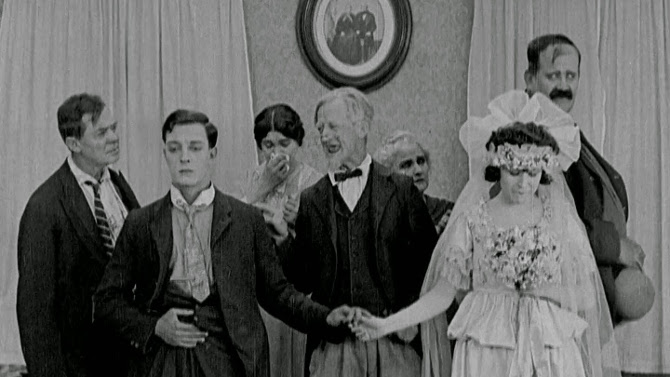
Boy Meets Girl
NeighborsDecember 6, 2017Long before Zac Efron and his fraternity bros started terrorizing new parents Seth Rogen and Rose Byrne in the 2014 comedy Neighbors, there was another movie with the same name, a superlative 1920 short from the great Buster Keaton (one of his first four shorts on his own). A tale of star crossed lovers, The Boy (Buster Keaton) and The Girl (Virginia Fox – originally one of Mack Sennett’s Bathing Beauties, she would marry major Hollywood mogul Darryl F. Zanuck, retiring from the business just a few years later) are madly in love, though the fence that separates their tenement apartments might as well be topped with barbed wire and armed with snipers, as their families despise each other – a feud rivalling the Montague’s and Capulet’s. Both fathers are especially involved in keeping the pair apart, though The Girl’s giant sized Father (Joe Roberts) is a much bigger threat than The Boy’s equally diminutive dad (played by Buster’s own father, Joe). Early each morning, they slip notes through a hole in the fence to communicate.
-
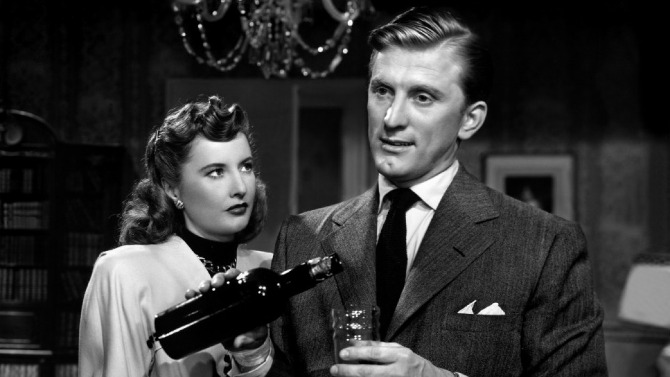
Grave Steps are Taken
The Strange Love of Martha IversNovember 26, 2017Uniting a superlative film noir cast, 1946's The Strange Love of Martha Ivers, directed by Lewis Milestone (a two time Academy Award winner, one of which he earned for All Quiet on the Western Front), begins with a triumvirate of childhood friends witnessing a crime which forges a unique bond between them, it informing their respective directions into adulthood. Building off of her performance in Double Indemnity two years earlier, Barbara Stanwyck, playing the title character, once again proves why she is one of the all-time great femme fatales. . . a calm, controlled, ruthless Machiavellian puppet master, she not only pulls the strings of her weak and feeble alcoholic husband Walter O’Neil (Kirk Douglas in his first film role – and against type from what we would later know) – who truly loves her, but she also has a manipulative control over the entire city in which she lives – owner of the plant that gives its people their jobs, the police that protect it (thanks to her husband, who is the district attorney), and everything else in between.
-
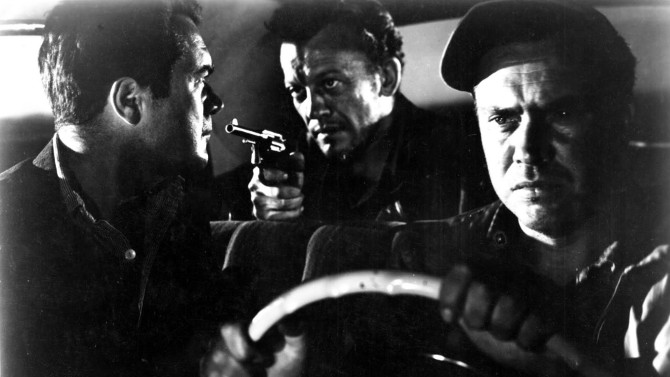
Hitching a Ride
The Hitch-HikerNovember 21, 2017Talk about an opening hook: “This is the true story of a man and a gun and a car. The gun belonged to the man. The car might have been yours – or that young couple across the aisle. What you will see in the next seventy minutes could have happened to you. For the facts are actual.” A perfect film noir introduction, the 1953 crime thriller The Hitch-Hiker, co-written and directed by Ida Lupino, is a seventy-one minute ride down a road you most definitely would not want to travel. In a simpler time (when people still picked up hitch-hikers), Emmett Myers (William Talman – best known as District Attorney Hamilton Burger on Perry Mason) utilizes this mode of transportation to evade the police. . . murdering those kind enough to pick him up. Dumping the body (or bodies) and abandoning the car, his thumb then goes up as he plays the stranded traveller – his two newest would-be-victims are Roy Collins (Edmond O’Brien – D.O.A.; White Heat) and Gilbert Bowen (Frank Lovejoy – In a Lonely Place; House of Wax).
-
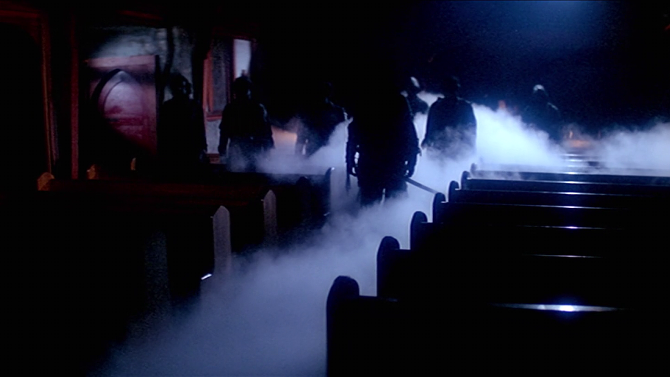
Weather Warning in Effect
The FogNovember 14, 2017There is something alluring about ghost tales being told in the darkness of the night. . . the way in which John Carpenter’s 1980 horror thriller The Fog opens – with a grizzled seafarer (John Houseman) recounting (to a group of wide-eyed children) the story of a ship of sailors who died in a horrific manner off of the coast of their small town one hundred years earlier. Building off of the success of his hit from two years earlier, Halloween, Carpenter once again shows his skills at developing an immersive world – this time creating a realistic ocean-side town packed with intriguing personas (in both films, he does so with a very limited budget). The locale, Antonio Bay, California, is celebrating its one hundredth anniversary, something the townsfolk are very proud of, especially Kathy Williams (Janet Leigh), one of the organizers of the festivities.
-
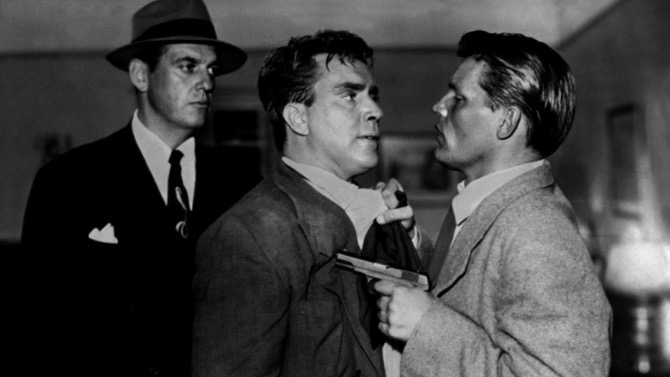
Death Becomes Him
D.O.A.November 12, 2017Talk about a hook of an opener – an extended tracking shot follows a man from behind as he enters a police station to report a murder. . . his own, and, rather interestingly, it seems as though the detectives were waiting for him. The man – Frank Bigelow (Edmond O’Brien); the film noir, D.O.A., a 1949 mystery directed by Rudolph Maté (a man who made several quality movies, though is better known for his superlative work as a cinematographer – think of Carl Theodor Dreyer’s two silent masterpieces The Passion of Joan of Arc and Vampyr, or later, Alfred Hitchcock’s Foreign Correspondent, Ernst Lubitsch’s To Be or Not to Be and Charles Vidor’s Gilda). Bigelow narrates his story to the men, transporting us back to the beginning of the tale.
-
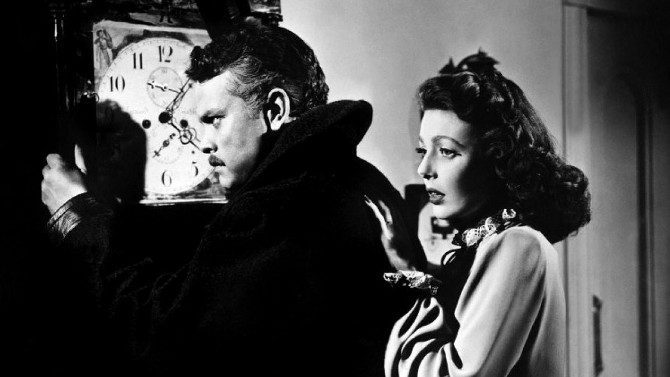
Strangers in the Night
The StrangerNovember 5, 2017It is Noirvember once again. . . the only time of the year when cynicism, doom-laden prospects and other dark themes should be sought out and applauded. The first film noir to grace Filmizon.com this November, 2017, is 1946's The Stranger. Directed by Orson Welles (his fourth feature, following the two classics Citizen Kane and The Magnificent Ambersons), this drama (with several film noir elements) follows Mr. Wilson (Edward G. Robinson – intriguingly, Welles originally wanted Agnes Moorehead portraying the lead as some sort of spinster lady), a sort of detective with the United Nations War Crimes Commission – or, to give his job a cooler name, he is basically a ‘Nazi Hunter’.