 Films That Matter
Pit Stop
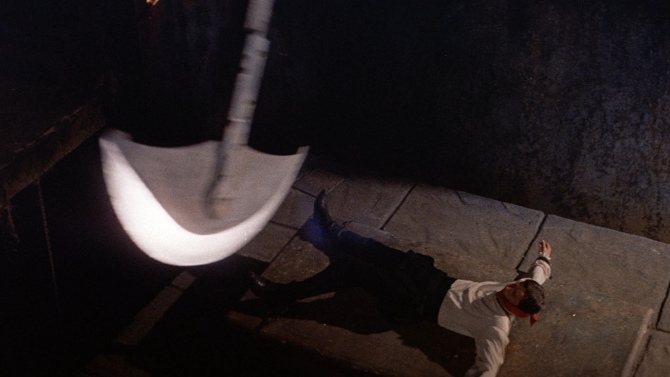
After Roger Corman’s major success with House of Usher (1960), he promptly turned to adapting another Edgar Allan Poe story to start a franchise of sorts, with The Pit and the Pendulum (1961) being an even bigger win... with it making over two million dollars on a modest budget of only three hundred thousand. Getting Vincent Price (House of Wax; Laura) back after House of Usher’s critical and commercial winnings, this time he plays Nicholas Medina, a tortured soul living in a tomb of a castle with his servants after his gorgeous wife Elizabeth (Barbara Steele – Black Sunday; The Horrible Dr. Hichcock) has seemingly died of a massive heart attack brought on by fright. Feeling as if he is truly cursed, he resides in the same place that his sadistic Spanish Inquisition father once tortured his victims, where his mother and uncle died, and now where his wife has met her untimely end. It has become so bad that even Nicholas’ sister Catherine (Luana Anders) has returned home to try and ease his sorrows.
-
Watch Out for Big Red
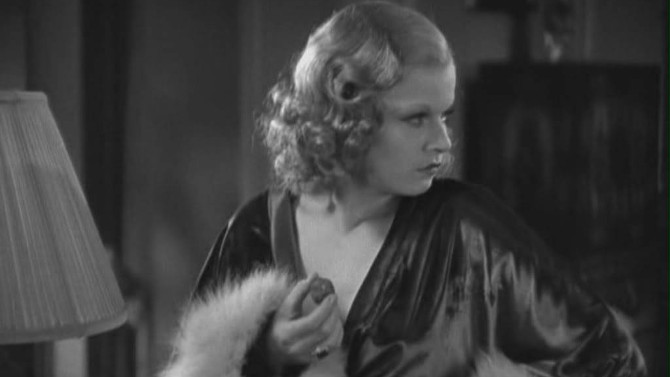
Red-Headed WomanSeptember 21, 2018“So gentlemen prefer blondes, do they?” What a way to open a film. . . famed platinum blonde Jean Harlow, face wrapped in a hot towel at a beauty salon, utters this self-referential line (in many ways breaking the fourth wall and speaking directly to the audience – her hair now dyed red), only for things to delve into more intriguing terrain. . . the next snippet finds the dame trying on a dress – asking if you can see through the material, the shop worker answers in the affirmative, to which she perkily states, “I’ll wear it”. Vignettes with a purpose, each moment gives us a viewpoint into the world of one Lil Andrews (Harlow), a Red-Headed Woman with a plan.
-
Hope For the Best
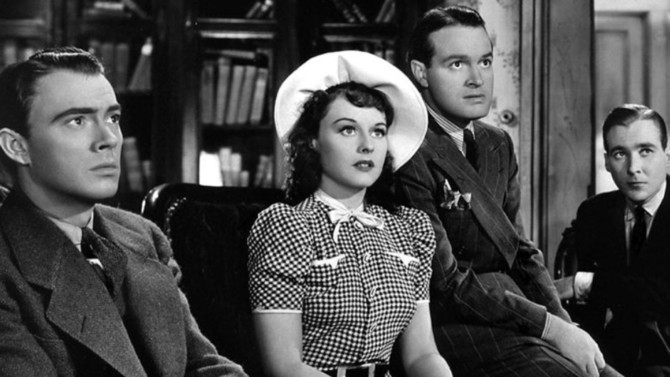
The Cat and the CanarySeptember 16, 2018A horror premise as old as it is entertaining, Elliott Nugent’s 1939 film The Cat and the Canary finds an extended family coming together for the reading of their uncle’s will – ten years to the day of his death. A remake of the 1927 silent classic (the idea came from a 1922 stage play of the same name by John Willard), screenwriters Walter DeLeon and Lynn Starling fuse the narrative with a deft comedic touch, resembling the Abbott and Costello horror features that were soon to come – movies that were magically able to play the horror parts for horror and the comedy parts for comedy. Set in a gothic-style plantation home in the middle of the Bayou, the vines envelop the property, the alligator filled water and lush landscape swallowing the dilapidated mansion that likely once stood out, a grand example of man conquering nature. Somewhat resembling Poe’s House of Usher, the property is managed by a mysterious and menacing housekeeper, Miss Lu (Gale Sondergaard) – it is implied that she was the owner’s mistress, a woman who welcomes (and I use that word loosely), the estate’s lawyer, Mr. Crosby (George Zucco), as well as Cyrus Norman’s only remaining heirs: famed actor Wally Campbell (Bob Hope) – who keeps guessing what will happen before it does thanks to his profession, fetching Joyce Norman (Paulette Goddard), mother and daughter Aunt Susan (Elizabeth Patterson) and Cicily (Nydia Westman), as well as nephews Fred Blythe (John Beal) and Charles Wilder (Douglass Montgomery).
-
The Truth, the Whole Truth, and Nothing But the Truth
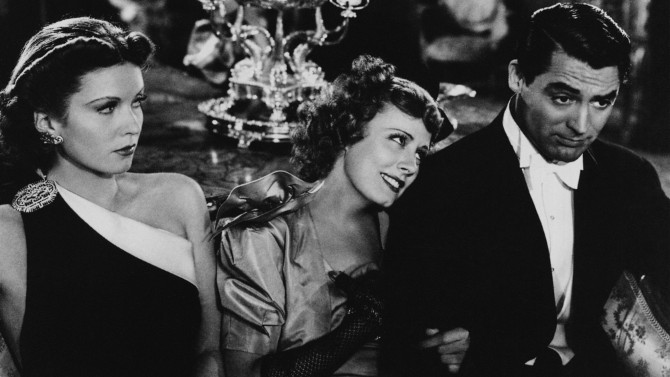
The Awful TruthAugust 26, 2018In one of the most frank speeches in Oscar history, Leo McCarey, upon winning the Academy Award for Best Director, took the statuette, and boldly stated, “I want to thank the Academy for this wonderful award. . . but you gave it to me for the wrong picture”. For those who have seen Make Way For Tomorrow, you will immediately know why he said it (a picture with a message and one of the great endings in film history, Orson Welles once claimed, “it would even make a stone cry”), but, that is not to say that the movie that he won for, 1937's The Awful Truth, is not deserving of some praise. A motion picture that helped put the screwball comedy on the map (The Awful Truth was based on a 1922 play by Arthur Richman and filmed twice before this version), it earned six Oscar nods (claiming the trophy for McCarey) – a darling to critics and one of the top commercial successes of the decade, while its irreverent mix of slapstick (it immediately evident that McCarey directed silent comedies; for example, the works of Charlie Chase and Harold Lloyd, while also pairing Laurel and Hardy together, and into the sound era, The Marx Brothers), witty repartee, and folly filled characters make it an absolute charmer.
-
Star Pick with Scott Wilson
 Battleship: Russian StyleBattleship PotemkinJuly 24, 2018
A while back, I sat down with the great Scott Wilson. Perhaps known more recently as Hershel on The Walking Dead, he has been busy carving out an interesting career over the past five plus decades. Starting off with roles in two classics, In the Heat of the Night and In Cold Blood, since, he has graced the silver screen in films such as 1974's The Great Gatsby, The Ninth Configuration, Johnny Handsome, Young Guns II, The Exorcist III, Dead Man Walking, Shiloh (and its two sequels), G.I. Jane, Pearl Harbor, The Last Samurai, The Host, and a small but integral turn in this past year’s Hostiles, while recently, he has appeared on television series including CSI: Crime Scene Investigation, Bosch, and The OA. . . this much shortened filmography gives you a small idea of the impact he has made in the industry.
-
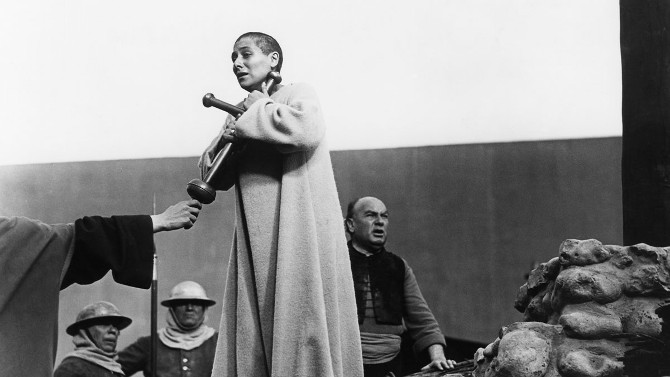
Jeanne Dark
The Passion of Joan of ArcJuly 15, 2018A tale with some eerie similarities to its real-life character, filmmaker Carl Theodor Dreyer set out to make a motion picture on the legendary Joan of Arc. Upon its completion in 1928 (The Passion of Joan of Arc), he was hounded by French nationalists, French government censors and the Archbishop of Paris, first complaining that a Dane (who is not Catholic) could not do justice to the greatest of French stories, then taking aim at the film itself – whitewashing the narrative (the French premiere eliminated the nastiness of the Judge and religious theologians and priests, as well as any other edgy visuals), thus leaving it in a truncated form that truly disgusted the screenwriter/director (a semblance of being tried by jury). Then, a truly disastrous event occurred – the original film negative burned in a fire at the UFA Studios in Berlin (a truly bizarre coincidence). . . the filmmaker distraught, was forced to piece the entire film back together by way of all of his discarded footage and alternate takes (a perfect example of the director’s extensive attention to detail, the movie was reconstructed to a very similar state that very few would be able to differentiate – though obviously Dreyer was less than pleased). Fate once again reared its ugly head when a lab fire burned this copy, leaving just a few extremely damaged prints (based upon both the original first and second cut) that had been circulated across Europe. Edited and changed by future hands, it was long believed that no one would ever see the man’s original vision again (the prints that survived were often missing twenty plus minutes, were chopped up and were changed to suit the meddling hands of re-releasers – some had added narration, others injected Baroque scores and changed the intertitles).
-

Zombification
Day of the DeadJuly 4, 2018They first appeared late one night, which then led to the dawn of a new, more frightening day. . . now, they own said day – the third in George A. Romero’s anthology zombie franchise, 1985's Day of the Dead finds a small group of desolate individuals attempting to survive the ever growing and encroaching human eating hordes, a task that is easier said than done. Featuring a three pronged attack, Romero (who writes and directs) utilizes touches of German Expressionism, 60s psychological horror (think Roman Polanski’s Repulsion) and brutal gore to keep his audience on its toes. Our survivors are cloistered away in an underground military camp – a ragtag team pieced together in the final days of organized chaos to search for some sort of cure for the growing number of undead. They do, from time to time, head out in their helicopter, searching for survivors – the famed Edison theatre in Fort Myers, Florida, can be seen in the opening sequence.
